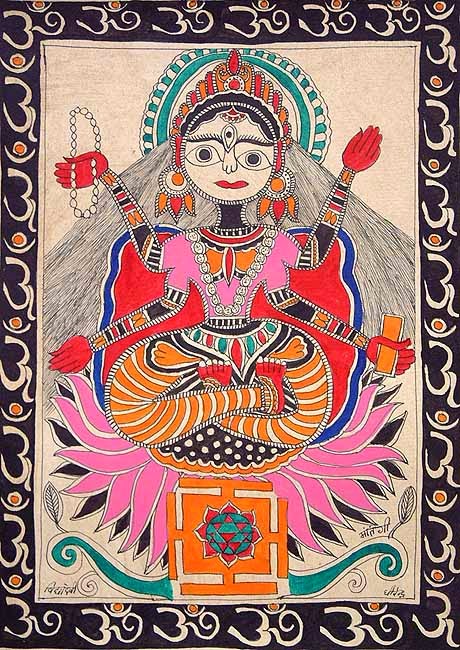
The last few years I have found myself very interested in Shakti, the goddess, and the exploration of female archetypes. I have taken three classes at LMU with Laura Amazzone around the Southeast Asian Goddess Traditions, co-hosted a monthly Goddess circle at my yoga studio, made yantras, recited mantras, and have done a lot of exploratory writing and art on the Goddess.

I have been working with Shakti in a personified way by relating myself to different goddesses. I am especially attracted to goddesses: Matangi, Tara, Kali and Saraswati. But Kashmir Shaivism seems to me to take Shiva and Shakti out of the personified God and Goddess forms into a more abstract identity.

Verse 3 of the Bodhapancadasika: Fifteen Verses of Wisdom reads “Shiva and Shakti are not aware that they are separate. They are interconnected just as fire is one with heat.”

Firstly, I want to explore who is Shiva. In Kashmir Shaivism the “ . . . Śiva that we are talking about here is referred to in the verse as Parameśvara, or Paramaśiva, i.e., supreme Śiva, and this is the Śiva that we relate to the supreme light of consciousness. Now, if you go to India, you can go to a temple. . . where you will find they’ve got statues of Śiva . . . you can find pictures of Śiva with Parvati and Ganesh, their son. These are much lower forms . . . we are not talking about that Śiva here. This idea of Śiva in Kashmir Shaivism, we have to make sure that we are not picturing Śiva in an embodied form there, because we are talking about Śiva as the light of consciousness.” (Webinar One, Kashmir Shaivism and The Transformation of Life)

As for Shakti, according to Swami Lakshmanjoo: “It was necessary for Śiva to recognize that Śakti within himself in order to create the universe. . . . Shakti is the whole universe. And from where this universe comes out is Shiva….This state of Lord Shiva and the state of the universe is interconnected with each other.”

For me, Shakti has always meant the goddess and feminine energy of the life force that pulses within. And this definition of Shakti as the the whole universe is a new concept.

In The Rise of the Goddess in the Hindu Tradition, Tracy Pintchman traces the origins of the Shakti. “In the Rig Veda , there appear to be two distinct meanings of the term : shakti denotes either “ability, power, capacity.” or “help, service.” In the Svetasvatara Upanishad 4.1 there is one supreme god who is described as bringing about the manifestation of the diverse world by applying his power or shaktis. In the Kumarila Bhatta, Shakti is the power inherent in all objects that determines the relationship between cause and effect.

Pintchman explains that it is not until the rise of Tantraism that Shakti becomes associated with the feminine.

In Tantra, the Absolute, although essentially singular, is understood to have female and male aspects.
 The female aspect is that of energy or Shakti. The male aspect of God cannot act alone but needs his energy, his Shakti, with whom he is inseparably united.
 Therefore, the supreme Shakti without whom God would be incapable of action, is ultimately responsible for the creation or manifestation of the cosmos. The created world arises through coupling of God and Goddess, Shiva and Shakti.

In Kashmir Shivaism, Shiva is the Absolute being or Source. Shiva out of a kind of play (svatantrya) divides himself from Shakti and then reunites with her and controls the universe through her.

The Shakti I have been exploring before this course comes out a binary model of Shiva-Shakti or masculine-feminine energies. “The idea that the great male gods all possess an inherent power by which or through which they undertake creative activity is assumed in medieval Hindu mythology. When this power, or Shakti, is personified it is always in the form of a goddess.”

Through this course, I understand that we are all Shiva and Shakti. And in the teachings of Kashmir Shaivism, since Shakti is part of Shiva, then we are all Shiva. “. . . there is only Śiva. In fact, Śiva and Śakti , that’s Śiva and his energies, that’s only one reality. That’s not two things. It’s not Śiva and then there is Śakti as a dualism, it’s one reality, like two sides of a coin. It’s one being.”
.

I have been thinking a lot about gender over the last year. Especially after I worked on the television show Transparent. My experience of gender before Transparent was that people were either gay, straight, or bi-sexual. That was my understanding of the world and it seemed complicated enough but very manageable. I knew straight people, I knew gay people and I knew bi-sexual people. Then I did Transparent and I learned of a whole other world that existed of transgender people.

I was assigned a transgender assistant, Van. She was very blonde, pretty and sexy. But her name was Van and her voice was deep. In the beginning, I kept referring to Van as “him” or” he”, even though in a transgender sensitivity training I was told that you use the pronoun that goes with how people present themselves. Since Van was dressing as a woman I should have been saying “she” or “her”.

My subconscious mind went to the sound of her voice, which she didn’t try to soften, and to her other masculine characteristics. Later, she explained to me that her ideology was that it wasn’t necessary to have a girl’s name or make a more feminine voice. She was happy with who she was and those affectations were not necessary.
Once after a long period of work, Van and I both had to go to the bathroom. The bathrooms on the TV show Transparent had been declared gender neutral. It was explained to the crew that a very difficult thing for transgender people is going to the bathroom because there is no appropriate bathroom for them and they are shamed in either bathroom they chose. So as I got to the bathroom Van entered first and hiked up her mini skirt and peed in the urinal. I was shocked spying a penis coming out of a denim cover. I went to the closed stall to urinate and think. I hadn’t realized that Van still had a penis. I had thought that she would have had it surgically removed.
Another time, when I thought it was appropriate I asked Van about her penis. I am not sure the exact wording I used, but I inquired if she was going to get rid of it. She told me that she would never get rid of her penis. She enjoyed it very much and it was a part of her. She even discussed further that some men found a pretty female with a penis to be very erotic. In sexual encounters, they enjoyed her in both her masculine and feminine aspects. So this was all news to me. At this moment, I realized what different worlds Van and I were living in and how little I knew about hers.

As I learned more about the transgender world and discovered that Facebook now has 58 gender options. I began to understand that gender is not simple or manageable. In fact, gender is very messy, personal and individual. Going beyond the dualism of male and female and embracing the monistic idea that we are all Shiva seems to be more appropriate for this multi-faceted world.

As I contemplate the third verse of the Bodhapancadasika,

I think about how the Shiva and Shakti exist within me.

I know that I am allegedly Shiva and I know that I am not fooling myself in thinking that I am Shiva when I achieve a blissful state. But I am not blissful. I am not happy with my career which takes up a huge part of my life. I don’t have enough time for my yoga practice. I am dissatisfied in general. But I do truly believe in self-realization being part of this world as John says in webinar six “Shaivism, our tantric tradition, is that we see that the world is really made, as we discuss again and again, that the world is made for realization, that the tools of the world, of Lord Shiva’s śhaktis (energies) are the tools that we take to have that reality, and that includes vision and tasting and hearing and walking and all the aspects . . . that we have in this world. All of those aspects can be used as ways of having that realization or finding that divine reality, which we are.”

I am beginning to realize that the life I am living is full of binaries that I don’t fit into: black/white, male/female, gay/straight. The binary system doesn’t leave enough room for diversity, intricacies, gray area and specificities. The ideas that we are all Shiva, and there is Shakti in all of us, and Shakti and Shiva are inseparable seems to leave more room for everyone (including myself) and be completely inclusive.

I am not ready to nor interested in giving up my non Kashmir Shaivite version of Shakti. I will continue my investigation and celebration of the Goddess, but as I do it, I will now have the awareness that beyond Goddess there is a higher form where we are all one with Source (referred to by some as Lord Shiva). And I am reminded of the quote from Galatians 3:28:
There is neither Jew nor Gentile, neither slave nor free, nor is there male and female, for you are all one in Christ Jesus.

I have been working with Shakti in a personified way by relating myself to different goddesses. I am especially attracted to goddesses: Matangi, Tara, Kali and Saraswati. But Kashmir Shaivism seems to me to take Shiva and Shakti out of the personified God and Goddess forms into a more abstract identity.
Firstly, I want to explore who is Shiva. In Kashmir Shaivism the “ . . . Śiva that we are talking about here is referred to in the verse as Parameśvara, or Paramaśiva, i.e., supreme Śiva, and this is the Śiva that we relate to the supreme light of consciousness. Now, if you go to India, you can go to a temple. . . where you will find they’ve got statues of Śiva . . . you can find pictures of Śiva with Parvati and Ganesh, their son. These are much lower forms . . . we are not talking about that Śiva here. This idea of Śiva in Kashmir Shaivism, we have to make sure that we are not picturing Śiva in an embodied form there, because we are talking about Śiva as the light of consciousness.” (Webinar One, Kashmir Shaivism and The Transformation of Life)
As for Shakti, according to Swami Lakshmanjoo: “It was necessary for Śiva to recognize that Śakti within himself in order to create the universe. . . . Shakti is the whole universe. And from where this universe comes out is Shiva….This state of Lord Shiva and the state of the universe is interconnected with each other.”
For me, Shakti has always meant the goddess and feminine energy of the life force that pulses within. And this definition of Shakti as the the whole universe is a new concept.
In The Rise of the Goddess in the Hindu Tradition, Tracy Pintchman traces the origins of the Shakti. “In the Rig Veda , there appear to be two distinct meanings of the term : shakti denotes either “ability, power, capacity.” or “help, service.” In the Svetasvatara Upanishad 4.1 there is one supreme god who is described as bringing about the manifestation of the diverse world by applying his power or shaktis. In the Kumarila Bhatta, Shakti is the power inherent in all objects that determines the relationship between cause and effect.
Pintchman explains that it is not until the rise of Tantraism that Shakti becomes associated with the feminine.
In Kashmir Shivaism, Shiva is the Absolute being or Source. Shiva out of a kind of play (svatantrya) divides himself from Shakti and then reunites with her and controls the universe through her.
The Shakti I have been exploring before this course comes out a binary model of Shiva-Shakti or masculine-feminine energies. “The idea that the great male gods all possess an inherent power by which or through which they undertake creative activity is assumed in medieval Hindu mythology. When this power, or Shakti, is personified it is always in the form of a goddess.”
Through this course, I understand that we are all Shiva and Shakti. And in the teachings of Kashmir Shaivism, since Shakti is part of Shiva, then we are all Shiva. “. . . there is only Śiva. In fact, Śiva and Śakti , that’s Śiva and his energies, that’s only one reality. That’s not two things. It’s not Śiva and then there is Śakti as a dualism, it’s one reality, like two sides of a coin. It’s one being.”
.
I have been thinking a lot about gender over the last year. Especially after I worked on the television show Transparent. My experience of gender before Transparent was that people were either gay, straight, or bi-sexual. That was my understanding of the world and it seemed complicated enough but very manageable. I knew straight people, I knew gay people and I knew bi-sexual people. Then I did Transparent and I learned of a whole other world that existed of transgender people.
I was assigned a transgender assistant, Van. She was very blonde, pretty and sexy. But her name was Van and her voice was deep. In the beginning, I kept referring to Van as “him” or” he”, even though in a transgender sensitivity training I was told that you use the pronoun that goes with how people present themselves. Since Van was dressing as a woman I should have been saying “she” or “her”.
My subconscious mind went to the sound of her voice, which she didn’t try to soften, and to her other masculine characteristics. Later, she explained to me that her ideology was that it wasn’t necessary to have a girl’s name or make a more feminine voice. She was happy with who she was and those affectations were not necessary.
Once after a long period of work, Van and I both had to go to the bathroom. The bathrooms on the TV show Transparent had been declared gender neutral. It was explained to the crew that a very difficult thing for transgender people is going to the bathroom because there is no appropriate bathroom for them and they are shamed in either bathroom they chose. So as I got to the bathroom Van entered first and hiked up her mini skirt and peed in the urinal. I was shocked spying a penis coming out of a denim cover. I went to the closed stall to urinate and think. I hadn’t realized that Van still had a penis. I had thought that she would have had it surgically removed.
Another time, when I thought it was appropriate I asked Van about her penis. I am not sure the exact wording I used, but I inquired if she was going to get rid of it. She told me that she would never get rid of her penis. She enjoyed it very much and it was a part of her. She even discussed further that some men found a pretty female with a penis to be very erotic. In sexual encounters, they enjoyed her in both her masculine and feminine aspects. So this was all news to me. At this moment, I realized what different worlds Van and I were living in and how little I knew about hers.
As I learned more about the transgender world and discovered that Facebook now has 58 gender options. I began to understand that gender is not simple or manageable. In fact, gender is very messy, personal and individual. Going beyond the dualism of male and female and embracing the monistic idea that we are all Shiva seems to be more appropriate for this multi-faceted world.
As I contemplate the third verse of the Bodhapancadasika,
I think about how the Shiva and Shakti exist within me.
I know that I am allegedly Shiva and I know that I am not fooling myself in thinking that I am Shiva when I achieve a blissful state. But I am not blissful. I am not happy with my career which takes up a huge part of my life. I don’t have enough time for my yoga practice. I am dissatisfied in general. But I do truly believe in self-realization being part of this world as John says in webinar six “Shaivism, our tantric tradition, is that we see that the world is really made, as we discuss again and again, that the world is made for realization, that the tools of the world, of Lord Shiva’s śhaktis (energies) are the tools that we take to have that reality, and that includes vision and tasting and hearing and walking and all the aspects . . . that we have in this world. All of those aspects can be used as ways of having that realization or finding that divine reality, which we are.”
I am beginning to realize that the life I am living is full of binaries that I don’t fit into: black/white, male/female, gay/straight. The binary system doesn’t leave enough room for diversity, intricacies, gray area and specificities. The ideas that we are all Shiva, and there is Shakti in all of us, and Shakti and Shiva are inseparable seems to leave more room for everyone (including myself) and be completely inclusive.
I am not ready to nor interested in giving up my non Kashmir Shaivite version of Shakti. I will continue my investigation and celebration of the Goddess, but as I do it, I will now have the awareness that beyond Goddess there is a higher form where we are all one with Source (referred to by some as Lord Shiva). And I am reminded of the quote from Galatians 3:28:
There is neither Jew nor Gentile, neither slave nor free, nor is there male and female, for you are all one in Christ Jesus.