Showing posts with label Manzanar Workshop. Show all posts

Monday, June 3, 2013

Watercolors around Lone Pine and Manzanar

I tried to paint a little different at Manzanar this year: bigger, bolder, more abstract.  I tried to have a high teachability index and do what I was taught at the demos.

This is a painting I did from a sketch at the Lone Pine Visitor center after a demo by David Deyell up at Reyes Adobe.

I did this at Reyes Adobe from a sketch at Lone Pine Visitor Center

I did this on location at Lone Pine Visitor Center

I did this at Lone Pine Visitor Center

I did this up at the Alabama Hills inspired by Chris Van Winkle's demo. I submitted it for critique.  I was advised to get more contrast between the blue mountain and the sky.

I did this in Bernie's Hotel room at the Dow Villa inspired by Al Setton's demo where I collected symbols to make a collage type painting.

Tuesday, May 21, 2013

Sketches in Lone Pine

Another year has gone by and I am back at the Henry Fukura workshop in Lone Pine/Manzanar.

Al Setton waiting to do his demo

At Spainhower ranch

More sketches Spainhower ranch

Value sketch at the Lone Pine Visitor Center

View of the Sierras

View from Lone Pine Visitor Center

View from the Visitor Center towards Mount Whitney

Sunday, May 27, 2012

Tom Fong Demo

These are images from the  Tom Fong demo.


 These are Tom Fong's sketches.


Henry Fukahura Paint Out - Year Two

I went to the Henry Fukahura paint out again this year.  Didn't get to be there 5 days like last year. But did some work.

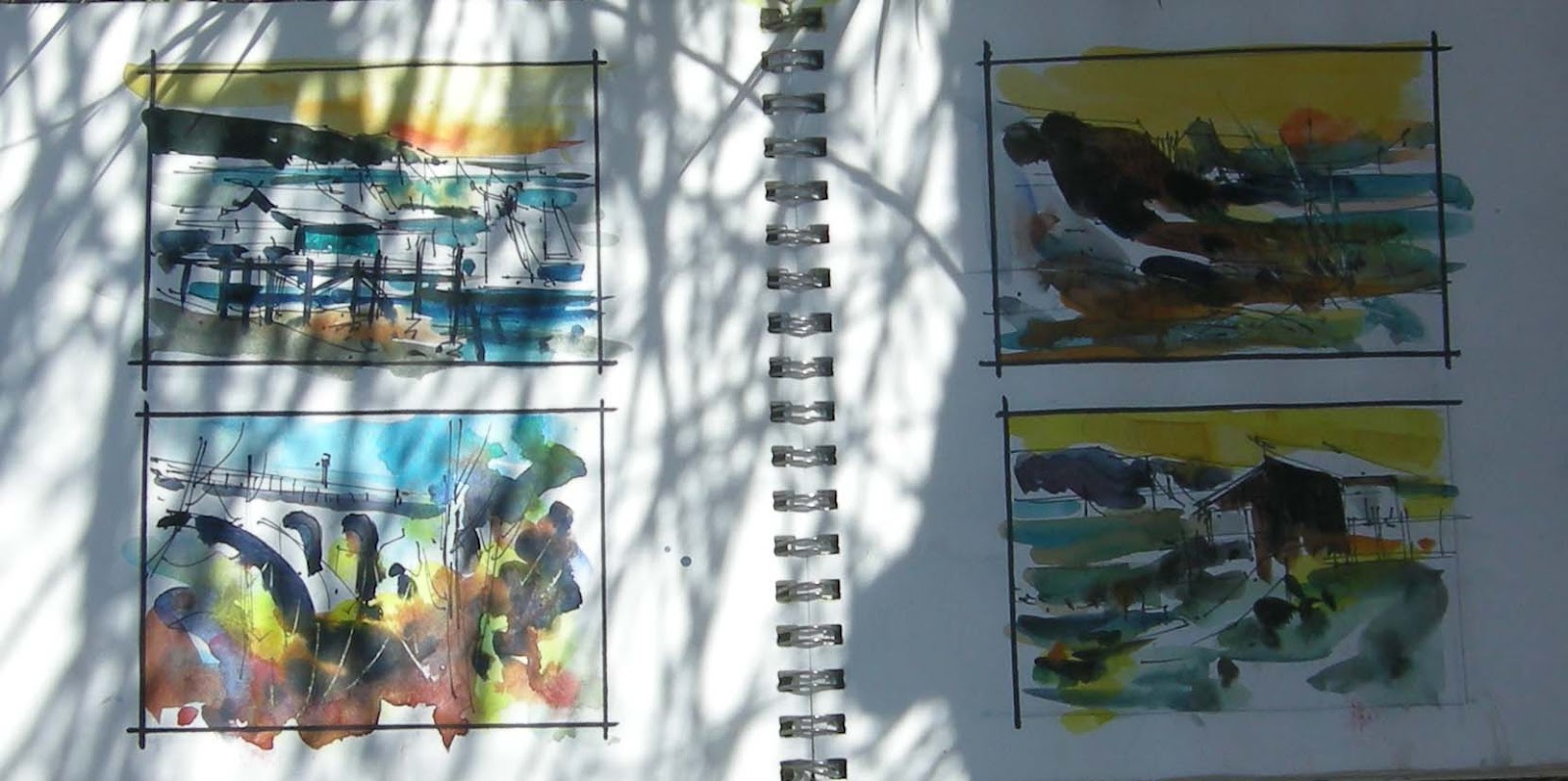
These are tiny watercolor sketches I did in my sketchbook of the Alabama Hills.


This is a 6" x 8" oil painting I did.
Here is another 6" x 8" oil painting that I did.
Another tiny watercolor.

Saturday, September 3, 2011

Art Show for Manzanar Workshop

Here are pictures of Bernie Vyzga and I with our paintings at the Manzanar exhibit.


Tuesday, May 17, 2011

MANZANAR WORKSHOP - Keeler - Jo Ann Formia - "Paint where you feel comfortable"


Monday I drew and painted in Keeler California.
According to Wikipedia:
"Keeler is a census-designated place (CDP) in Inyo County, California, United States. Keeler is located on the east shore of Owens Lake 11.5 miles at an elevation of 3602 feet (1098 m). The population was 66 at the 2000 census. . . . When the 1872 Lone Pine earthquake rendered the pier in nearby Swansea inaccessible by uplifting the shoreline, a new pier was constructed to the south at a community named Hawley.
In 1880 a new mill was constructed at Hawley by the Owens Lake Mining and Milling Company for processing ore from the Cerro Gordo Mines in the mountains to the east. A town was laid out by the company agent Julius M. Keeler, for whom the town of Hawley was later renamed. . There was a 300-foot wharf at Keeler, and the steamship route cut days off the time for a freight wagon to circle the lake. .
The Carson and Colorado Railroad constructed a narrow gauge railway to Keeler in 1883. The success of the Cerro Gordo mines caused Keeler to boom until silver prices plummeted in the late 1800s. A second boom of zinc mining in the early 1900s brought new life to the town and a tramway was built to bring the ore from Cerro Gordo to Keeler.
Train service was stopped in 1960 and the tracks were removed in 1961. Water exports from the Owens Valley to the City of Los Angeles in the 1920s led the Owens Lake to eventually dry up, causing alkali dust storms to blow through Keeler, driving many residents away. Dust remediation efforts in the early 21st century reduced this problem, but few residents remain."


Jo Ann Formia did the demo at Keeler. She studied with Henry Fukuhara and Milfred Zornes. She is the president of Watercolor West. Jo Ann makes her own greens. She makes sketches and the paints outside where she feels comfortable not necessarily looking at the subject. She uses Bochenford paper. She uses a big brush and blocks in. She laughed that there is always an ugly stage in your painting. She uses American Journey paints from Cheap Joes. She says don't paint from you painting paint from your sketch. She often makes sketches of sketches to distill down to the most simple information and not getting caught up in the details.

MANZANAR WORKSHOP - Manzanar - It's much better to ruin a painting than do a safe painting - Chris Hero

On Sunday we painted at Manzanar
According to Wikipedia
"Manzanar is most widely known as the site of one of ten camps where over 110,000 Japanese Americans were imprisoned during World War II. Located at the foot of the Sierra Nevada in California's Owens Valley between the towns of Lone Pine to the south and Independence to the north, it is approximately 230 miles (370 km) northeast of Los Angeles Manzanar (which means “apple orchard” in Spanish) was identified by the United States National Park Service as the best-preserved of the former camp sites, and was designated the Manzanar National Historic Site."


Chris Hero did the demo Sunday at Manzanar.


Here are my notes: Thinking is done in the sketchbook. He paints against the traditional use of watercolor media. He likes to use a crayon as a resist. He says you know you are in trouble when you get out the little brush. He says he doesn't talk about colors that much he talks about warms and cools. White is a cool.


He says "it's much better to ruin a painting the do a safe painting." He says when you watch a demo for two things 1) What you never want to do or 2)things you would like to borrow. He says instant coffee and tea make great drawing inks. He works from memory a lot. He always knows he is going to take a painting back into the studio.


He says Manzanar is a prison camp not just any place is Owens Valley. This needs to come across in the painting. In the best artmaking technique and content are in balance somewhere in the middle is the sweet spot.


MANZANAR WORKSHOP - Alabama Hills - Al Setton: "As soon as you put away your big brush and get out your little brush you're in trouble."

Today we painted at the Alabama Hills.
According to Wikipedia: "Alabama Hills are a "range of hills" and rock formations near the eastern slope of the Sierra Nevada Mountains in the Owens Valley, west of Lone Pine in Inyo County, California. Though geographically considered a range of hills, geologically they are a part of the Sierra Nevada mountains."


The Demo Today was by David Deyell. "David paints in the "California Style"; entertaining, happy, bright, colorful paintings. Emphasis on composition, values, brush strokes, shapes and symbols, strong contrasting colors."

My Notes from the Demo:

He worked with McKim, Meade and white. Influenced by Tony Couch and Edward Whitney.He emphasizes making a value plan. You need to make a plan before you paint. He often said: DESIGN, CREATE and COMPOSE.

He likes Richardson Paper and Brushes. He starts his watercolors by sketching in Sharpie. With the Sharpie he stresses looking for thick and thin lines, continuous lines. You need to have a reason. Have a center of interest.

Try to paint the most difficult part first. Paint hardest to easiest. Be a composer not a copier. If are an artist destroy the brush and make it work for you. Don't treat it like you are a housepainter and are going to pass the brush on. Don't use the brush as if you were painting a barn. If you spend 3/4 of your time outside you will learn more. Turn painting upside down from time time. Henry would never have a blue sky.


The critique in the evening was by Al Seton. "Artist Al Setton's work captures California's joyful and energetic, yet sophisticated and laid back ambiance. Educated at Cairo University, the University of Santa Cruz, and the California Art Institute, Al Setton's paintings clearly reflect the influences of Fauvism and Abstract Expressionist masters in addition to the work of recent masters such as Henry Fukuhara, Rex Brandt, Robert E. Wood, and Kathryn Chang Liu. It is clear that Setton has developed his own personal vision of life which engages and excites the viewer. The artist's hand is evident in his work with visible, energetic brush strokes, unique markings, and spills and drips, which make the viewer aware of both the flatness of the surface and the quality of paint application while being entertained by deceivingly simple subject matter."

Here are my notes: Don't be limited by the nature that's out there. Interesting shapes have some interuption like sides of a jig saw puzzle Move things around in nature to make intersting shapes. Each corner should look different. Paint 80 to 90 percent on location and then put the painting away and see it with fresh eyes. Move color around through painting.

Do not follow local color. Create new colors by overlapping, create interest with calligraphic lines. Darks attract attention. Be careful about having to many clumps of grass. Make sure the painting is entertaining.

Know where you want the viewer to look. The eye looks at the lightest light against the darkest dark. You can use scrap paper with watercolors on it to check things out in the studio. You can create movement in your painting by having the perspective a little off.

As soon as you put away your big brush and get out your little brush you are in trouble. Don't leave the sky plain. Turn your painting upside down, sideways and squint at it.