Wednesday, August 10, 2016

Siddhartha: A Yoga Therapy Perspective, Creating a Safe Space

f) From the chapter, OM:
Siddhartha sat down next to the old man, slowly he started talking. What they had never talked about, he now told him of, of his walk to the city, at that time, of the burning wound, of his envy at the sight of happy fathers, of his knowledge of the foolishness of such wishes, of his futile fight against them. He reported everything, he was able to say everything, even the most embarrassing parts, everything could be said, everything shown, everything he could tell. He presented his wound, also told how he fled today, how he ferried across the water, a childish run-away, willing to walk to the city, how the river had laughed. While he spoke, spoke for a long time, while Vasudeva was listening with a quiet face, Vasudeva's listening gave Siddhartha a stronger sensation than ever before, he sensed how his pain, his fears flowed over to him, how his secret hope flowed over, came back at him from his counterpart. To show his wound to this listener was the same as bathing it in the river, until it had cooled and become one with the river.

Question: An important part of Siddhartha’s healing was when he was finally able to express all of his feelings and to be heard completely. How do you create a safe space for your clients and students to express their feelings while maintaining safe and healthy boundaries both for them and for yourself?


My answer to this question is greatly influenced by the reading I have been doing for the Life Force Yoga training I will take in November at Soul of Yoga.  Amy Weintraub writes about making a safe container.Her ideas include: The client has permission to stop a practice or process and any time. The repetition of a simple ritual at the beginning of each session. (Lighting a candle or a Centering Practice).


In my own yoga therapy practice, I try to explain what I am doing, why I am doing it, and that I am learning.  I also practice active listening and try not to interrupt or fix anything. I tell the client if anything doesn’t feel right just let me know.


In my therapeutic classes I begin with a mudra meditation and a formation of sankalpa. My yoga therapy individual sessions have been following the IYT protocol.

While in session,  I give lots of eye contact, read body language as best I can, and get feedback as I am going on.  I also try to start and end on time. I work in a clean and pleasant room.  Tell them that everything is confidential.  I try to give a lot of positive reinforcement and encouragement during the session.

My boundaries are staying to the time of the session. I do offer my number and let people call or text me if something is wrong.  I feel healthy boundaries is something that I need to work on.  I would like to charge everyone even if it's a dollar for the session for the idea of energy exchange.  But I haven't done that so far.

Most important is that my personal yoga practice contains the elements I use in the Yoga Therapy session and that I believe that what I am doing is helpful. To quote Haruki Murakami, Kafka on the Shore“I'm safe inside this container called me.” I believe when I feel safe and secure they will feel safe and secure.


Monday, August 8, 2016

Siddhartha: Balancing Empathy and Compassion

Here is the question

From the chapter, OM:

Differently than before, he now looked upon people, less smart, less proud, but instead warmer, more curious, more involved. When he ferried travellers of the ordinary kind, childlike people, businessmen, warriors, women, these people did not seem alien to him as they used to: he understood them, he understood and shared their life, which was not guided by thoughts and insight, but solely by urges and wishes, he felt like them. Though he was near perfection and was bearing his final wound, it still seemed to him as if those childlike people were his brothers, their vanities, desires for possession, and ridiculous aspects were no longer ridiculous to him, became understandable, became lovable, even became worthy of veneration to him. The blind love of a mother for her child, the stupid, blind pride of a conceited father for his only son, the blind, wild desire of a young, vain woman for jewelry and admiring glances from men, all of these urges, all of this childish stuff, all of these simple, foolish, but immensely strong, strongly living, strongly prevailing urges and desires were now no childish notions for Siddhartha any more, he saw people living for their sake, saw them achieving infinitely much for their sake, travelling, conducting wars, suffering infinitely much, bearing infinitely much, and he could love them for it, he saw life, that what is alive, the indestructible, the Brahman in each of their passions, each of their acts. Worthy of love and admiration were these people in their blind loyalty, their blind strength and tenacity. They lacked nothing, there was nothing the knowledgeable one, the thinker, had to put him above them except for one little thing, a single, tiny, small thing: the consciousness, the conscious thought of the oneness of all life. And Siddhartha even doubted in many an hour, whether this knowledge, this thought was to be valued thus highly, whether it might not also perhaps be a childish idea of the thinking people, of the thinking and childlike people. In all other respects, the worldly people were of equal rank to the wise men, were often far superior to them, just as animals too can, after all, in some moments, seem to be superior to humans in their tough, unrelenting performance of what is necessary.


Question: An important part of Siddhartha’s transformation is that his experience with his son awakened within him the heart of compassion and he could understand others as being like himself and could honor the life those around him were living. How do we find a balance in yoga therapy between compassion and empathy for our students and clients while maintaining a space of neutrality and objectivity?

“Becoming a father, I think it inevitably changes your perspective of life. I don't get nearly enough sleep. And the simplest things in life are completely satisfying. “ - Hugh Jackman


I don’t have any children so I haven’t experienced this part of what it means to be human, the change, that occurs and is expertly described in Siddhartha when he moves out of narcissism to oneness and universality through the role of being a parent. I feel like I missed something great by not experiencing motherhood.  That I didn't achieve my full self.  It is one of my main regrets, a source a grief, loss and longing. And yet it is my story, who I am. A woman who did not become a mother.


I did have the opportunity to help raise my cousin Lucretia’s son Bryce and I feel like my life is much richer for the experience. And this experience of helping with Bryce has given me some small insight into being a parent.

Even without the direct experience of motherhood, I do sometimes feel a glimmer of universal
oneness as described by the character Siddhartha.

“Slowly blossomed, slowly ripened in Siddhartha the realization, the knowledge, what wisdom actually was, what the goal of his long search was. It was nothing but a readiness of the soul, an ability, a secret art, to think every moment, while living his life, the thought of oneness, to be able to feel and inhale the oneness. Slowly this blossomed in him, was shining back at him from Vasudeva's old, childlike face: harmony, knowledge of the eternal perfection of the world, smiling, oneness. (11.3)”

Although the question only asks about empathy and compassion I believe it also important to address sympathy. Sympathy, empathy and compassion are essential concepts when relating to others needs and suffering in yoga therapy. I define sympathy is feeling sorry for another person’s hurt or pain.Sympathy implies and emotional distance.  When feeling sympathy you are not experiencing that pain as if it is your own. And I am not sure if sympathy is really helpful or useful for the therapist or the student/client.

For me, empathy is “walking in another’s shoes.”  With empathy we are able to experience for ourselves some of what the other person is experiencing.  In empathy there is a human connection and the knowledge that we all too feel pain, grief, loss . . .  Empathy is very important. I think my empathetic nature is what draws students to me.  They perhaps feel that I can understand what they are going through and that seems to be really important.


Compassion, I define, as the ability to translate the experience of empathy into action. With compassion we put our own needs aside and take on the needs of the suffering person.  The ultimate compassion person for me is Mother Teresa.

. “At the end of life we will not be judged by how many diplomas we have received, how much money we have made, how many great things we have done. We will be judged by "I was hungry, and you gave me something to eat, I was naked and you clothed me. I was homeless, and you took me in.”
- Mother Teresa

What is my ideology about the balance between compassion and empathy. I think without empathy there is no yoga therapy. But as for compassion, as a householder, I cannot put all of my clients needs above my own.  Then I would not be true to my personal commitments as wife, yogini and artist.  What I want to do is help my clients develop their own self-compassion so that they experience and be responsible for their personal transformation.  I believe that the changes you make for yourself are the most important.  I would offer to them the words of Rumi:


“Don't be satisfied with stories, how things have gone with others. Unfold your own myth.”


I strive to be a compassionate yoga therapist and human.  I do hold at my core principles of activism as fundamental to who I am. If compassion means to “to suffer together” and feel motivated to relieve the suffering of thers then compassion is what has brought me to want to be a yoga therapist in the first place. But if compassion means being a renunciate and putting everything above my family then that is not who I am.


For me. staying neutral and objective is very important to yoga therapy.  I think the main way for me to stay neutral and objective is to keep consistent with my own yoga practice and self development. My yoga practice needs to always be a balanced 8 limb practice and my self-development comes through yoga, art and writing.


“One of the most important things that the therapist need to do is deal with and resolve his or her own issues before beginning to practice on therapy on others. When therapists attempt to help clients resolve issues they are dealing with, it makes it extremely difficult to remain neutral or the therapist might confuse themselves over the role they serve.”
 https://www.mentalhelp.net/blogs/compassion-vs-empathy/

When I find myself in a balanced state is when I can best serve others from a place of neutrality and objectivity.  When I am overworked, overtired, emotional, sad then I lose objectivity and neutrality. Audre Lorde best expresses in this quote.

“Caring for myself is not self-indulgence, it is self-preservation, and that is an act of political warfare.” 

Sunday, July 3, 2016

Siddhartha, A Yoga Therapy Perspective: Techniques to Ground Yourself in the Present Moment

Yet another question on Siddhartha

d) From the chapter, The Ferryman: “Yes, Siddhartha,” he spoke. “It is this what you mean, isn’t it: that the river is everywhere at once, at the source and at the mouth, at the waterfall, at the ferry, at the rapids, in the sea, in the mountains, everywhere at once, and that there is only the present time for it, not the shadow of the past, not the shadow of the future?” “This it is,” said Siddhartha. “And when I had learned it, I looked at my life, and it was also a river, and the boy Siddhartha was only separated from the man Siddhartha and from the old man Siddhartha by a shadow, not by something real. Also, Siddhartha’s previous births were no past, and his death and his return to Brahma was no future. Nothing was, nothing will be; everything is, everything has existence and is present.” 

Question: One of the main factors in stress and illness is that students and clients are constantly involved in the guilt of the past and plans / expectations / worries of the future. Siddhartha learns that nothing exists but the present moment. How do the tools and techniques you use in yoga therapy help to ground your students and clients in the present moment?


Dakota Lupo my teacher this morning for the Bikram Series said “Presence is a practice.” He stressed that our eyes should remain open in the yoga poses. “Don’t close your eyes and drift into an imaginary world, be here now in this hot room with the bright lights and your sweaty towel tired and frustrated on Saturday morning. “


I, too, believe we must practice being present.  One place we can practice being present is on the Yoga mat.  I believe large hatha poses like Warrior 1 and 2, Triangle and Side angle have wonderful presencing effects. To practice these poses we need to ground and focus.


Also balancing poses require being in the present to achieve (Tree, Balancing Stick, Standing Bow Pulling Pose, Toppling Tree, Warrior 3 and its variations).  The challenge of balancing brings our awareness into the present moment. When are minds wander we usually fall out of the pose. When teaching these poses,  I remind students to notice and accept what is happening right now without judgment or reaction.


In my Hatha Class after we warm up with the Pawanmuktasana/The Joint Freeing Series and move to standing I give I talk when we come to Tadasana about how to stand in the present moment.  I ask the students to lean forward – that’s living in the future (what am I going to have for dinner tonight, shoot I need to go to Trader Joe’s). Then I ask them to lean back – that’s living in the past (I shouldn’t have talked to my husband that way. Yesterday sucked at work). I ask them to lean to their right that’s the masculine side (their strength and power). Then lean to their left – that’s the feminine (love and compassion). Now finally stand straight on both feet in the here and now. “It's being here now that's important. There's no past and there's no future. Time is a very misleading thing. All there is ever, is the now. We can gain experience from the past, but we can't relive it; and we can hope for the future, but we don't know if there is one.” - George Harrison


In Yin Class, I teach asanas that have to do with the root chakra to ground and presence the class. Poses like toe squat, saddle, flamenco, caterpillar and rag doll all address the root chakra by accessing the legs.

Also in yin I remind students to experience the pose. And continue to reexperiene over time. Don't camp out and get comfortable and drift away. Be at your compassionate edge and feel the pose.


The body rotation in Yoga Nidra is a presencing technique that I feel is highly effective.  When I go through the rotation I ask the students to either bring awareness to the body part, repeat the name or visualize the body part. I stress that it’s very important to chose and use one of these techniques. If emphasize that if you don't follow along with the body scan the presencing will not be achieved.


In meditation, mantra meditation is my preferred method of presencing.  I enjoy chanting to Lakshmi, and Saraswati. Sometimes just calling on them by their bija mantras: Shreem and Aim.


Mudra Meditation is also a new technique that I am using at the beginning and end of class for grounding and presencing.  Being in the present is so important and something I stress over and over when I am teaching yoga. In the words of Mother Teresa:  “Yesterday is gone. Tomorrow has not yet come. We have only today. Let us begin.”

Saturday, June 4, 2016

Siddhartha: A Yoga Therapy Perspective, The True Self

Now I have moved on to question C in my Yoga Therapy Assignments on Siddhartha.

Siddhartha gained an insight beyond concepts or descriptions. This is given as the final “goal” in most spiritual paths. From a yoga therapy perspective, this insight into one’s true nature is the essence of healing. Once it is achieved, health at all other levels of being often occurs spontaneously. To what extent can you guide your yoga therapy students and clients to a perception of their true Self while creating a space of comfort in which they can continue their everyday lives?

“The Buddha taught that our true nature is emptiness- a lack of a permanent Self- and when this true nature is realized, the divine states of the Brahma-viharas - loving-kindness, compassion, empathetic joy, and equanimity- emerge. There is also a state of mind and heart known as bodhichitta that leads one to completely dedicate oneself to the liberation of all beings from suffering. In the teachings of the great yoga masters, our true nature is Brahman, the universal soul, of which the individual soul is simply a part. When this is realized there is satchidananda, the awareness of bliss, from the knowing that pure awareness is our ultimate nature.” - Philip Moffit


The name Siddhartha means “one who has accomplished a goal.” Siddha from the Sanskrit meaning goal and Artha meaning accomplished. The spiritual goal can be called Nirvana, Enlightenment, Moksha, Samadhi, Union, Bliss, Joy, True Self, Insight, Inner Peace, Ease, True Nature . . . I would share with my students that self-acceptance and self-exploration are the tools for Self-Realization.

No one can gives us happiness or health we have to find it for ourselves and in ourselves.  We can have everything we “need”  but without  understanding of the true Self we are not at peace.

“That was how everybody loved Siddhartha. He delighted and made everybody happy. But Siddhartha was not happy. Wandering along the rosy paths of the fig gardens, sitting in contemplation in the bluish shade of the grove, washing his limbs in the daily baths of atonement  . . there was yet no joy in his own heart. . . Dream and restless  thoughts came flowing in him  . . . Dreams and restlessness of the soul came to him.” Herman Hesse


I would encourage my students to use their yoga and meditation practice to explore questions like: Who are you? What is your true nature? What brings meaning to your life? Who and how do you love?

“Truly, nothing in the world has so occupied my thoughts as this I, this riddle, the fact I am alive, that I am separated and isolated from all others, that I am Siddhartha! And about nothing in the world do I know less about than me, about Siddhartha!. . . I will learn from myself, be my own pupil; I will learn from myself the secret of Siddhartha.” Herman Hesse

 Challenges that bring people to Yoga Therapy can be the catalyst for exploration and transformation.  When  everything is going well their is usually is a lack of interest in self-discovery,  It is with life challenges and misfortune that we begin to endeavor  to learn how to respond to pain, suffering  and confusion and act from our true Self.

“...the commitment to find your true nature is often lost in the ordinariness of life; there is less inspiration, and you are beguiled by the tyranny of routine and the collective humdrum of all those around you seeking material advantage.” PM. 


Deepak Chopra lists some qualities of the true Self I would share with my students.
1) The True Self is certain and clear about things.  (The everyday self gets influenced by countless outside influences).
2) The True Self is stable.  (The everyday self shifts constantly).
3) The True Self is driven by a deep sense of truth. (The everyday self is driven by the ego and always uses words like I, me, mine.)
4) The True Self is love.  (The everyday self seeks love from outside sources.)


I would recommend practices like Karma Yoga (Service to Others), Coherent Breathing, Restorative Yoga, Morning Pages, Directed Journaling, Yoga Nidra and Meditation (Mindfulness, Walking and Mantra) to connect with the True Self.  I would attempt to make this investigation comfortable for the students by stressing there is not right or wrong with any of these practices. I would also talk to them about understanding of the true Self might not be verbal, it can be a feeling, or an ease in the mind or body. I would emphasize that all these investigations should come from a place of self-love and self-compassion leaving out judgment and competition.

". . . having compassion for yourself is most important. Instead of calling yourself unkind names, take a moment to speak sweetly as if to a child." - Nischala Joy Devi


“You can search throughout the entire universe for someone who is more deserving of your love and affection than you are yourself, and that person is not to be found anywhere. You yourself, as much as anybody in the entire universe deserve your love and affection.” – The Buddha


Monday, May 30, 2016

Siddhartha: A Yoga Therapy Perspective, Releasing the Guilt of the Past


  QUESTION: Siddhartha’s transformation is the ability to embrace his own history, to see that everything he had done and been was a necessary part of his awakening. This ability to release the guilt of the past is an essential part of the healing process. How can you support your yoga therapy students and clients in coming to peace with their own history?


In the three Yoga Therapy sessions I have performed using the IYT Protocol there are many questions about personal history asked to the student. The time we spend going over personal history confirms the importance of our personal story. Our story is our journey, our journey is who we are.  We can’t change our story or our journey we need to make peace with it in order to grow. I would share with my students, when I was young I wanted life to be linear I believed in destinations but as I age I see life is more circular or sometimes even without a geometric equivalent.


I often think about this quote from Maya Angelou “Oh, I’ve lived a roller coaster life, there has been this disappointment and that satisfaction, and then it begins all over again. Or maybe it’s one of those terrible rides that not only goes round and round, but also dips at the same time.” I would tell my students we can’t change the past, we can only accept the past as the past, and try to leave the past in the past.  The only thing that is real is the present moment. We don’t want to be stuck and non-reality. Non-reality is everything that isn’t the present moment.


“Yes Siddhartha,' he said. 'Is this what you mean: that the river is in all places at once, at its source and where it flows into the sea, at the waterfall, at the ferry, at the rapids, in the ocean, in the mountains, everywhere at once, so for the river there is only the present moment and not the shadow of the future?'

'It is,' Siddhartha said.'And once I learned this I considered my life, and it too was a river, and the boy Siddhartha was separated from the man Siddhartha and the graybeard Siddhartha only by shadows, not by real things. ... Nothing was, nothing will be; everything is, everything has being and presence.”


All parts of our journey make us who we are.  If we left a part out we wouldn’t have been ourselves. My mother often talked about the Robert Frost poem The Road Not Taken in response to me ruminating over making a decision or second guessing a decision I had already made.  She explained with every path we take there are many paths we don’t take and all of those are lives that may have been viable and interesting but they are no longer our path.  Siddhartha could have obeyed with father stayed with his family and never went to the forest to live with the samanas. Siddhartha could have stayed with the samanas for the rest of his life, but he didn’t.  Siddhartha could have been the follower of the Buddha Gautuma, but he chose not. Siddhartha could have spent his life in the town with Kamaswami and Kamala, but he didn’t.  He took the path the seemed right to him and the time. 


Two roads diverged in a yellow wood,
And sorry I could not travel both
And be one traveler, long I stood
And looked down one as far as I could
To where it bent in the undergrowth;

Then took the other, as just as fair,
And having perhaps the better claim,
Because it was grassy and wanted wear;
Though as for that the passing there
Had worn them really about the same,

And both that morning equally lay
In leaves no step had trodden black.
Oh, I kept the first for another day!
Yet knowing how way leads on to way,
I doubted if I should ever come back.

I shall be telling this with a sigh
Somewhere ages and ages hence:
Two roads diverged in a wood, and I—
I took the one less traveled by,
And that has made all the difference.


For me sometimes there are two paths sometimes there are even many options. I try to follow and advise others to follow the path of the heart. Carlos Castaneda in the Teaching of Don Juan explains “Before you embark on any path ask the question: Does this path have a heart? If the answer is no, you will know it, and then you must choose another path. . . A path without a heart is never enjoyable. You have to work hard even to take it. On the other hand, a path with heart is easy; it does not make you work at liking it.”

In regards to Siddhartha's circuitous path and his acceptance of the nonlinearity of his life this passages is the one that strike me the most.


"How strange his life had been, he thought. He had wondered along strange paths. As a boy I was occupied with the gods and sacrifices, as a youth with asceticism,,,, I’ve learned to conquer my body. I then discovered with wonder the teachings of the great Buddha. I felt knowledge and the unity of the world circulate in me like my own blood, but I also felt compelled to leave the Buddha and the great knowledge. I went and learnt the pleasures of love from Kamala and business from Kamaswami. I horded money, I squandered money, I acquired a taste for rich food, I learned to stimulate my senses. I had to spend many years like that in order to lose my intelligence, to lose the power to think, to forget about the unity of things. Is it not true, that slowly and through many deviations I changed from a man into a child? From a thinker into an ordinary person? And yet this path has been good and the bird in my breast has not died. But what a path it has been! I have had to experience so much stupidity, so many vices, so much error, so much nausea, disillusionment and sorrow, just in order to become child again and begin anew. But it was right that it should be so; my eyes and heart acclaim it. I had to experience despair, I had to sink to the greatest mental depths, to thoughts of suicide, in order to experience grace, to hear OM again, to sleep deeply again and to awaken refresh again. I had to become a fool again in order to find Atman in myself. I had to sin in order to live again. Whither will my path yet lead me? This path is stupid, it goes in spirals, perhaps in circles, but whichever way it goes, I will follow it.”

As for transformation, Carol Myss, I recall saying in a lecture on spiritual alchemy that in order to have gold in our lives we must be willing to let go of some lead. I see the lead as the ability to release guilt of the past in order to fully embody the present. Tadasana is my favorite pose to use to teach about being in the present moment. I have people plant their feet on the ground first leaning forward (that is the future), then leaning back (the past), then leaning to the right (the masculine), then to the left (the feminine), then I ask them to plant themselves in the present moment to inhabit the here and now.

The Buddha is quoted to have said, “The past is already gone, the future is not yet here. There's only one moment for you to live, and that is the present moment.”

Deepak Chopra also reaffirms, "In every moment we have the opportunity to awaken. To let go of whatever fear constriction and stories are running through our mind as we become fully into the present moment. And it is only in the present moment that we can experience happiness.


In order to heal we can release the guilt of the past and embrace the present moment. Healing is a present moment activity.


Saturday, May 28, 2016

Exploring the Poses: The Warrior Archetype and Yoga


(all quotes are from the Four Fold Way unless noted with the author’s name)
Believing you can be perfect is the fatal imperfection,
Believing you’re invulnerable is the ultimate vulnerability.
Being a Warrior doesn’t mean winning or even succeeding.
It means risking and failing and risking again, as long as you live …
- Richard Heckler, In Search of the Warrior Spirit.

During a modern vinyasa yoga class we are taken through a series of poses known by the names of warrior.  These poses include Warrior 1, 2, 3, humble warrior, exalted warrior, reverse warrior and so on.. A colleague at work once expressed to me his lack of understanding of why yoga would have poses called “warriors” when it was supposed to be a peaceful system of movement.  My teacher, Joseph Le Page, renamed all the warrior poses Hero in his book, The Yoga Toolbox.  For me, I never had a problem with the poses being called warrior.  I thought of the disciple and duty of the samurai and the idea of exploration, journey and quest. I remember Shiva Rea in a workshop asking us to pull back our bows and stand strong in Warrior 2.  I felt like the Goddess Artemis/Diana getting reading for the hunt.  I understood warrior as a way to tap into my personal power. I have just read the book

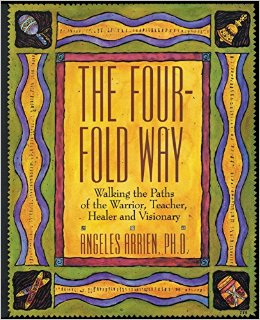
“The Four-Fold Way: Walking the paths of Warrior, Teacher, Healer and Visionary” and the book his helped me further my thoughts about the Warrior poses and why I love them more and really enjoy their names.

Warrior Poses are strong poses that demand complete attention. As we hold longer and deeper we must chose to be present.  Sometimes my teacher will challenge us further by asking the class to close their eyes.
“I can’t believe that!” said Alice.
“Can’t you?” the queen said in a pitying tone. “Try again, try again, draw a long breath, and shut your eyes.”
Alice laughed. “There’s no use trying,” she said. “One can’t believe impossible things.”
“I daresay you haven’t had much practice,” said the queen. “When I was your age, I always did it for half an hour a day. Why, sometimes I’ve believed as many as six impossible things before breakfast.”
- Lewis Carroll
When we hold these Warrior poses over time and get stronger we realize that many things we thought were not possible can begin to become possible.  We realize that we have personal power.  “The principle that guides the Warrior is showing up and choosing to be present.” First there is presence. Then comes the lifting the arms, followed by planting the feet.  We continue by making sure the position is balanced.  And we test our stamina by holding the pose as we strive for our personal healthy alignment. “The developed Warrior shows honor and respect for all things, employs judicious communication, sets limits and boundaries, is responsible and disciplined, demonstrates right use of power . . .”

Different Warrior Poses and Variations: Warrior 1


This is a pose of discipline. We plant the back leg down with the foot at an angle, the front knee is over ankle, and the arms are up to the sky. “The word ‘disciple’ actually means ‘being a disciple unto oneself,” When we are disciples unto ourselves, we honor our own rhythm, our step-by-step nature…Discipline and responsibility are the Warrior’s tools for honoring structure and function.”
Sometimes we enter Warrior 1 from standing in Tadasana or Mountain Pose. Tadasana is a standing meditation. The pose expresses the concept I am here and I am ready. “. . . it is not uncommon in these (Shamanistic) societies for individuals to pray for long periods of time in a standing postures during vision quests…. (standing meditation) is used in martial arts, spiritual practices and the military as a way of reinforcing and coalescing the three universal powers of presence, communication, and position, which allows us to connect with the greater being who we are.””
 “The Warrior demonstrates the willingness to take a stand. This is the capacity to let others know where we stand, where we don’t stand for, and how we stand up for ourselves. Think of Surya Namaskara B when you step the leg forward from downward facing dog into a low lunge and then raise your arms and chest into  Warrior 1.  This is a big dramatic stand.  You need the flexibility to steep your leg through the strength to rise the torso up, and the commitment to lift the arms over head. My favorite variation of Warrior 1 is when we put our hands in prayer overhead thanking the divine for her help in our lives.

Warrior 2

 “. . . outwardly, he stands in physical readiness for any call to service, and inwardly, he strives to fulfill the Way . . . Within his heart he keeps to the ways of peace, but without he keeps his weapons ready for use.”
Warrior 2 is a pose about respect.  Respect comes from the Latin respicere to be willing to take a second look.  In Warrior 2, the body is facing one way but the head looks over the shoulder.  We are not stuck or limited to one particular point of view which would have the head facing in the same direction as the chest. We are multi-dimensional beings willing to face one way and look the other. “If we want to access the Warrior archetype and become effective leaders, we must be willing to look at our many real abilities rather than focus on just one or two parts of who we think we are.”
This pose is also about understanding what we want. “When we say “yes” when we mean “no” we lose personal power and become victims or martyrs.”  In Warrior 2 we align our feet, legs, arms and become stable and lastly we set our gaze.  We take responsibility for our body making it stable and secure. “Responsibility is not only the ability to respond to what comes toward us, it is also the capacity to stand behind our actions and to be responsible for all that we do or don’t do. … Our ability to respond impeccably and with integrity to the events we create brings is into the Warrior’s arena.”


Exalted Warrior/Reverse Warrior


Similar to the Bodhisattva Vow in Buddhism in which we don’t choose our personal enlightenment but instead stay on earth to help others achieve enlightenment“. . . the Warrior’s task to become visible, and through example and intention to empower and inspire others.”  The Warrior is not just working alone and taking all the credit for his/her successes.  In Exalted Warrior pose we exalt ourselves to god and bask in her presence.  But in this pose the bow is an upward bow instead of one in which we lower ourselves.  This is a bow up to heaven.  The hope is that our reverence and beauty in the pose will inspire the reverence and beauty in others.

Humble Warrior


In contrast to Exalted Warrior, in Humble Warrior we bow down low. We show ourselves as flexible and strong, with a willingness to humble ourselves.  We do not lose our strength or power through this act of humility, it is part of what gives us strength and power. We also interlace our fingers and bring our arms over head showing we are without physical weapons instead we are here to be the instrument of service.

Warrior 3

In Warrior 3 we begin to fly.  Balancing on one leg on the ground and one in the air we begin our launch. In this pose we know that impossible things can happen.  In Warrior 3 we learn to transcend the body and transcend any fear about the necessity to be grounded.  We let go over our attachment and soar towards higher and loftier goals.

Conclusion

“The archetype of the Warrior requires us to use power in an enlightened way that incorporates integrity, alignment of speech and action, honor and respect, and serves humanity fairly and justly.”

As we practice these poses, we can explore the boundaries of our body, mind and heart. We don’t have to consider the warrior as an aggressor but think of the warrior as an explorer of our internal universe.  In Warrior we plant are feet on earth as we reach for the sky.  We strive to be secure in the foundation of who we are as we invite personal growth and transformation. We reach, exalt, humble ourselves, inspire and honor. We keep our intention and sense of self as we journey through life open to all possibilities.

Monday, May 23, 2016

Siddhartha: A Yoga Therapy Perspective, By The River

Part of the Practicum to be a certified Yoga Therapist for Integrative Yoga Therapy is to do some journaling from questions from Herman Hesse's Siddhartha. Here is my attempt to answer question A.

a) In the chapter, By the River, Siddhartha becomes depressed and almost commits suicide. He then has a vision that transforms his life and sets him on a new phase of his journey. Many of those who come to you in yoga therapy will be in a situation not too different from Siddhartha. They’ve lived their lives according to a certain set of beliefs and these have become questioned, often in the face of illness. Have you experienced a major turning point like this in your life? Have you also seen it in your yoga students? Describe one of these experiences.

I first want to give the context of the Chapter, By the River.


“He wished passionately for oblivion, to be at rest, to be dead… Was there any kind of filth with which he had not besmirched himself, any sin and folly which he had not committed, any stain upon his soul for which he alone had not been responsible? Was it then still possibly to live? Was it possible to take in breath again and again, to breathe out, to feel hunger, to eat again, to sleep again… Was this cycle not exhausted and finished for him?” pps.87-88

"Then from a remote part of his soul, from the past of his tired life, he heard a sound. It was one word, one syllable... the holy Om, which had the meaning of..."Perfection"." pg 89


In 2011, I was hired for the Set Decorator position on a very big budget TV show on a major network.  It was the first time in my life that I had secured such a prestigious position. There were many people with more experience than myself who had been up for the job but I was the one chosen.  It felt like I had received the fruits of what I had been working towards for the last fifteen years of my life.  I was the Set Decorator on a big network TV show. This was what I thought I had always wanted.

But straight out of an episode of Fantasy Island my fantasy of being a Decorator on a big TV show was in fact a nightmare.


 I was working 20 hours a day, I  got shingles from stress. No matter how hard I worked I couldn’t seem to get the work done.  I first lost ten pounds and then I gained 40. A big budget meant big expectations and I was much more of manager of labor and resources than a creative person which I thought I was hired for.  I had no kind of life. I was completely exhausted, on edge and overworked. and I had work related nightmares when I finally did go to sleep.
Then, all of the sudden, the show was cancelled.  It was also rumored that the episodes I had worked so hard on were not going to even air.  There had been a regime change at the network and the new regime didn’t want anything to do with the old one. All the projects from the old regime were being shelved. I couldn’t believe it.  I had worked so hard, even sacrificing my health for something that wasn’t even going to see the light of day.  And why had I worked so hard? I didn’t love the material, I didn’t even like the job.  My supervisors were incredibly difficult to work with.  And now that I had received my fantasy I didn’t want it.  Was this what I had been working for all these years?

“There is perhaps nothing worse than reaching the top of the ladder and discovering that you’re on the wrong wall.”
― Joseph Campbell

I hadn’t enjoyed my career already for ten years.  But I had convinced myself if the budgets were bigger, if the projects were prestigious, if had more crew, then everything would be better.  But here I was on the bigger, better, prestigious project and it was worse than the little jobs I had been embarrassed about working on.  On the little jobs at least I was creative. Here I had to delegate all the creative aspects of my job in order to be available for meetings, tech scouts and managing personnel.

And was that what my life was going to look like now? Working 16 to 20 hours a day for the rest of my life? Why does film and television have to always be so hard?  Why can’t we work an 8 hour day like most people?  Why is 12 hours the bare minimum?  I had given up so many things already for this career, I had given up having children,  having friends, yoga, and even my own health to step up to the impossible expectations that seemed to be always demanded of film and television production people.  I had kept telling myself it would get better, it would change, and instead it kept getting worse.

I knew the expectations of TV and Film would never change.  I would have to change. I would have to change careers.  I would have to take breaks and I would have to say “No.”  And my breaking point was that I had worked so hard for a project that wasn’t even going to be seen.

No, this Film/TV life was never going fulfill me.  I was never going to be made whole by dressing sets. God hadn’t put my on this earth to work so hard decorating imaginary places for imaginary people there must be something else that I could do.  Something I could do and feel good about that wouldn’t leave me sick and exhausted.  I needed to search for that.