Thursday, June 29, 2017

VAJRA MUDRA

I have taught Vajra Mudra a couple of times over the last few weeks.  I teach it in Lunar Hatha when ever we are on the day of Vajreshwari, the lunar nitya.


I also taught the mudra for Chapter 3 of Arists Way class on discovering your personal power and I taught in my Yin Class on Transforming Fear.


Vajra Mudra's core quality is self-empowerment. "Vajra means "diamond," referring to the diamond shape formed by the fingers in Vajra mudra. This gesture directs breath, awareness and energy into the third chakra, awakening our "inner diamond" of energy and vitality. This mudra enhances empowerment, determination and clarity, supporting the unfolding of all of our unique talents and possibilities. This gesture also enhances the movement of the diaphragm, creating a massaging effect that supports the health of the digestive system while increasing circulation to the area of the mid back, kidneys and adrenal glands." - Joseph Le Page

In Himalayan Bowl Training I learned about placing the vajra on the body to move energy to areas of need in the clients body.  I also learned how to clear chakras with a crystal vajra.


Here are the instructions for making the mudra.


1.       Touch the tips of the thumbs to the tips of the index fingers of each hand.
2.       Bring the thumbs and index fingers of each hand together.
3.       Join the pads of the middle fingers together, forming a diamond shape.
4.       Curl the little and ring fingers naturally inward toward the palms.
5.       Hold the gesture at the solar plexus with the middle fingers facing forward.
6.       Relax the shoulders back and down, with the elbows held slightly away from the body and the spine naturally aligned.

I've written about the diamond before. Vajra is also part of the yoga pose Varjrasana which is called in English Thunderbolt pose.

Supta Vajrasana is part of my regular Bikram Yoga Practice.  It is called Fixed-Form but it could also be translated as sleeping diamond or thunderbolt pose.  The pose is considered the healer of the knees.


That has come to me in meditation.  I like the concept of the what I call "the diamond self."  In buddhism there is a sutra that has the  Sanskrit title Vajracchedikā Prajñāpāramitā Sūtra, which may be translated roughly as the "Vajra Cutter Perfection of Wisdom Sūtra." In English, the shortened forms of the sutra are the Diamond Sūtra and Vajra Sūtra. The title comments on the power of the vajra (diamond or thunderbolt) to cut things.   This cutting is the wisdom that cuts and shatters illusions to get to ultimate reality.  The Diamond Sūtra has also been highly regarded in a number of Asian countries where Mahāyāna Buddhism has been traditionally practiced. :"Its major themes are anatman (not-self), the emptiness of all phenomena (though the term 'śūnyatā' itself does not appear in the text), the liberation of all beings without attachment and the importance of spreading and teaching the Diamond sutra itself."


Four Main Points of the Diamond Sutra described by Hsing Yun

1) Giving without attachment to self
2) Liberating beings without notions of self and other
3) Living without attachment
4) Cultivating without attainment.

For me these are all Yogic Principles in the Yamas and Niyamas and lead to the Diamond Self.


When I did Joseph Le Page's guided Mudra Meditation for Vajra I experienced in a new way.  I really felt the diamond.  I understood the mudras shape.  My thumbs felt like the top of the diamond and my index fingers were the base.  My Diamond self was shining out into the universe as well as reflecting the universe.  I heard the words "self-esteem, confidence and life purpose" very clearly.  It reminded why I wanted to be a Yoga Therapist and have done so much to try to be on this path.

The affirmation
"My inner jewel shines brilliantly, empowering me to manifest my life vision completely."  
doesn't go with my understanding of what vajra means to me.


My affirmation is

"I cut through, shatter and release all attachments in order to discover my true self."


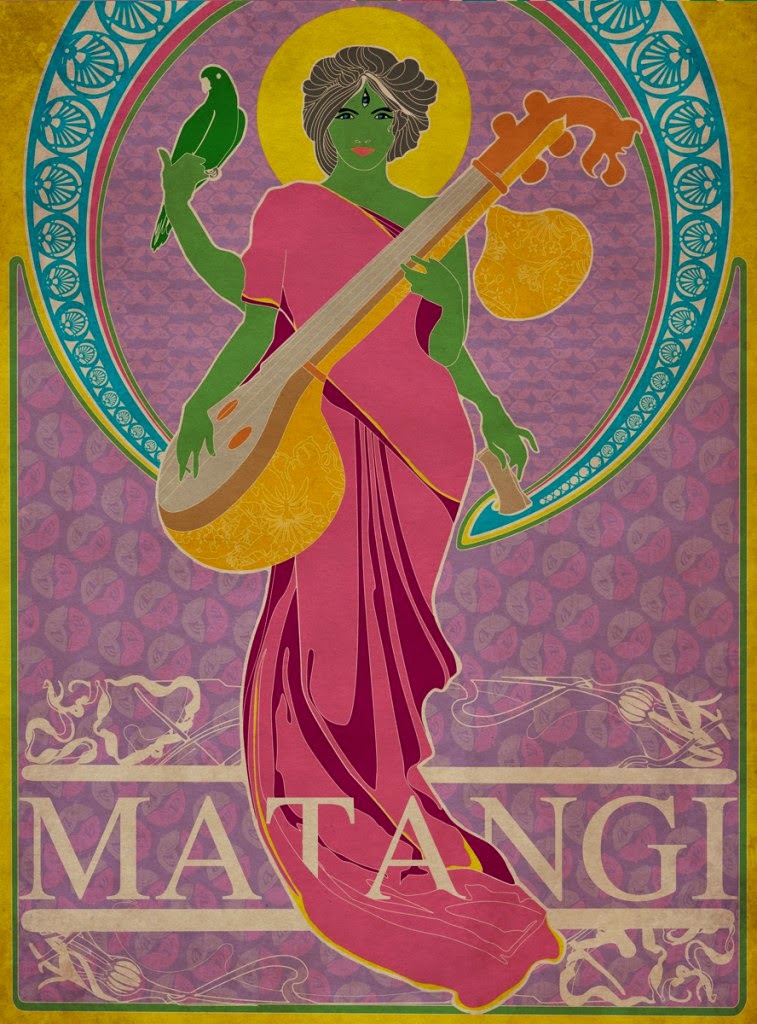
MATANGI MUDRA

I have written a lot about Matangi on the blog.   When I found out she had a mudra I was overjoyed.


Mata means thought or opinion. Matangi is the goddess of thought and mind Matangi is the dark mystic, ecstatic or wild form of Saraswati. . . Saraswati is often a goddess of only ordinary learning, art and culture. Matangi rules over the extraordinary, which takes us beyond the boundaries of
convention…She is that part of Sarasvati that is allied with the transforming energies of
Kali.” (Frawley 1994: 140)

In the many descriptions of Matangi, she holds in her four hands: a noose, a sword, a
goad and a club. The noose is an instrument to hang the demons and deterrents to creative process
and personal. The noose may kill ego in order to make room for true nature and authentic self.
The sword cuts through fears and opposition and allows us to be the hero-ine’s of our own
story filled with strength and fearlessness. The goad, like a hook, encourages us to move
forward and remove all obstacles and troubles from our dharmic paths. The club celebrates our primitive nature, and reminds us to stay strong against self-doubt and any other enemies. The club also symbolizes devotion and surrender to a higher power.


Matangi is yama, the dark one. She encourages us to slow down and just sit and rest.“Creativity may involve ecstatic outpourings that are joyous and free, but it always also involves spending time in uncertain places which are frightening and unknown, times when all there is to do is to wait (for
the seeds to germinate), for the bread to rise, for the editor to get back with the comments on the
manuscript). All these, aspects of creativity are part of the process. Matangi’s great power is to be equally at home in all these phases.” (Dinsmore-Tuli, p. 309-310)

Matangi is worshipped with "food from stained hands and lips,” which is a huge reversal of
Hindu rituals that are usually obsessed with purity. She asks for leftover food, which is normally
considered highly polluting, because she emerged from leftover food. “Her special siddhi is the capacity for abundant creativity and the expression of unique vision.” (Dinsmore-Tuli, p. 309)

Matangi is beautiful and unapologetically sexual. One of her names according to Kinsley is “she whose limbs are intoxicated (with passion).” Mata means thought, opinion, wild, and passionate.

Matangi brings awareness of the ebb and flow of the creative process. We can’t force ourselves to create when it is not the time. She reminds us to be in the present moment and take it for what it is.
“Just as there is no point in pressing a woman for sexual intercourse if she is too tired, or too
premenstrual or otherwise at the wrong time of her particular cycle, so too there is no point
in pushing for productivity in the reflective or evaluative phase of the creative cycle.”

Her seat in the human body is the throat, the fifth chakra. It is in the throat chakra that we
speak our truth. “She also resides in the tip of the tongue, the place where in speech is
articulated and wherein we are able to taste the essence of things.” (Frawley, p.142)

In addition, Matangi, the elephant goddess, is related to the ear and our ability to listen and
understand.  “Creativity and sexuality are two sides of the same coin.” (Dinsmore-Tuli, p.309)

Matangi is an avatar of Parvati when she dressed as an untouchable to seduce Shiva.
According to Kinsley, Matangi has a few other origin stories besides the Parvarti-Shiva
seduction. The first form is a Buddhist tale about hunter Matanga and his daughter
Prakrti (an early form of Matangi) who falls in love with Ananda. Ananda first encounters
Prakrti when he is looking for water. She refuses to give him water because of her low
caste.

Ananda responds “I am not asking you what your caste is, I am only asking for water.”
Affirmed as a person who is not just an outcaste, she becomes instantly enamored.Prakrti uses her mother’s magic to attract Ananda, who falls for her but later resists herwith the help of the Buddha.
Impressed by the power of the Buddhist teachings, Prakrti becomes a Buddhist nun.

There is also the story Uccista-matangi, who animates from remnants of the food Vishnu
and Lakshmi gave Shiva and Parvarti at a dinner party.Shiva blesses her with the ability to grant
people to control their enemies and obtain objects of their desire by repeating her mantra.

Because the guru instructs through the spoken word, Matangi represents the teachings of a
guru and the guru tradition.

Matangi is the jester. “…. her status as an outcaste gives her the power to inhabit the outer
regions of consciousness where no-one else will go, to say outrageous and alarming things, to be
vilified, despised and humiliated, and through it all to remain surrendered with a clear pure heart
so that what needs to be manifested can find its way out.” (Dinsmore, p. 309-310)

Matangi is also sometimes considered the daughter of the Rishi Matang/Matanga and
she was given to him as a boon for his merits as a sage. “Playing a ruby-studded vina,
ecstatic, delighting in sweet speech, I remember the daughter of the sage Matanga, who has soft dark- emerald limbs.” (Frawley, p.142)

“The Tantrasara at several points says that by meditating upon, reciting the mantra of, or
worshipping Matangi one gains power over others, the power of having everything one
says come true, and the power of attracting people.” (Kinsley, p.220)

“Matangi’s voice is brave and terrifying to those who are constrained by fear to live their
lives according to propriety and expectations. She rattles people, pokes holes in their comfortable boxes of convention, and embarrasses the cowed and silent by singing loud and clear.” (Dinsmore-Tuli, p.312)

I worked with Matangi Mudra using Joseph and Lilian Le Page's guided meditation for Matangi Mudra.  I felt a warm yellow energy current extending straight out of my solar plexus.  The words that stuck with me from the meditation were "Life Purpose", "releasing what no longer supports your life journey" and "allowing you to overcome all obstacles along your journey."

The affirmation was
"The golden current empowers me  with abundant energy and vitality/"

My Matangi affirmation

"I am a dark creative and sensual woman."


Monday, June 26, 2017

Adho Merudanda Mudra

"“Adho” means downward and “Merudanda” is the axis of energy. In this mudra, the thumbs, which
represent the fire element, are extended, but they are turned downward. As a general principle, mudras that are turned downward represent the lunar principle, which is cooling, while those that are
turned upward represent the solar element, which is heating. This mudra is therefore a combination of heating and cooling elements, which stimulates the abdominal and navel areas as well as the second chakra. Its physiological focus is on the reproductive and digestive systems." - Joseph Le Page


I practiced Adho Merudanda Mudra for 10 –20 breaths as a tool to bring awareness to the lower abdominal and navel segment of my body.  I noticed the lack of tone in my stomach that is making my back work to hard.  I also noticed my tendency to lean forward and that I have a hard time sitting up straight.  My stomach felt empty and healthy besides the lack of strength.  Maybe this strength - a solar plexus issue - extends beyond my stomach to all avenues in my life where I need to develop my strength.  I have a tendency not too chew food enough and eat to fast which is hard on my stomach.  I think my stomach is asking for strength, support and care as we age together.  I have been doing some barre classes to work on this area.  Yoga Barre really shows me how weak I am in my core.  I will also go back to LaGree when I start working next week.  I promise to take care of my stomach and not ignore it like I have more so many years.


Adhi Mudra

"“Adhi” means foundation, which refers to its focus at the base of the body. It also means primordial, which refers to the source energy lying dormant in the base of the body and represents our latent potential for spiritual evolution. In Adhi Mudra, the thumbs, which represent the fire element, are held into the hands by the fingers, showing that the creative force is still held at the very base of the
body. Adhi Mudra, therefore, brings awareness and opening to the lower pelvis and the first two chakras. Its physiological focus is on the eliminatory system." - Joseph Le Page


I practiced Adhi Mudra for 10 – 20 breaths, bringing awareness to this lowest energetic segment of your body. I noticed the stillness and grounding of my body.  I also notice a soreness and tightness in my anus and the slight pain in the right side of my knee.  These are issues I have been experiencing lately some constipation and dehydration and some knee injury I triggered in yoga a couple of weeks ago.  I am working on my eliminatory system and strengthening the knee.  Today I am going to try to rest it because I think I have been pushing on it too hard.


Wednesday, June 21, 2017

Dirgha Pranayama using Purna Svara Mudra.

Here is my exploration of Dirgha Pranayama using Purna Svara Mudra.


My experience:

My breathing feels strong and heavy in the belly.  It feels like breathing is moving from the chest to the belly with the weight in the belly. The breath almost seems to be asking for a pause in the belly. Feels like a curved breathing

Visualizations and Imagery:

I see a strong waterfall as I hold the mudra
I also see:
Strong waves of the Atlantic Ocean

Newport Avenue in Ventnor, New Jersey and the Bagel Place


Other Sensations:

The smell of the Ocean

My left tremor is activated and I am shaking in the Mudra


Here is what Joseph Le Page says about the mudra

"CORE QUALITY
Complete Breathing

ESPECIALLY HELPFUL FOR
• Facilitating Full Yogic Breathing, which may be helpful for respiratory conditions.
• Releasing tension from the entire torso.
• Supporting health and healing in all systems of the body.
• Integrating body, mind and spirit.

INSTRUCTIONS
1.       Touch the tip of the little finger of each hand to the base joint of the thumb.
2.       Touch the tip of the ring finger to the middle joint of the thumb.
3.       Touch the tip of the middle finger to the tip of the thumb.
4.       Rest the backs of the hands on the thighs or knees.
5.       Relax the shoulders back and down, with the spine naturally aligned.

Purna means "full" or "whole," and svara means "breath." Purna Svara refers to Dirgha Pranayama, Full Yogic Breathing. Purna Svara mudra naturally cultivates Full Yogic Breathing, which we experience as a wave of energy flowing throughout our entire torso. This complete breathing integrates the three areas of the torso (base, middle and top) and the three portions of the lungs (lower, middle and upper). This gesture releases tension from the abdomen, diaphragm, rib cage and the auxiliary muscles of respiration in the shoulders and neck, permitting freer breathing and enhanced lung capacity. The Full Yogic Breathing facilitated by Purna Svara mudra supports the health of all of the systems of the body.

Purna Svara mudra instills a sense of integration and harmony throughout our entire being. This integration is activated by the placement of the fingers along the thumb. The little fingertip pressed into the base of the thumb activates the breath in the lower body and the base of the lungs, and is associated with the Sthula sharira, the physical body. The ring fingertip pressed into the middle joint of the thumb activates the breath in the middle body and middle portion of the lungs, and is associated with the Sukshma sharira, the energy body. The middle fingertip, which touches the top of the thumb, activates the breath in the upper body and top of the lungs, and is associated with the Karana sharira, the causal body. The position of the fingers pressed against the thumb integrates the three bodies simultaneously while the extended index finger serves as a pointer to our true being, which encompasses and transcends all of them."

Tuesday, June 20, 2017

Dirgha Pranayama without a mudra

I just completed 5 minutes of Dirga Pranayama with no mudra. I concentrated a lot on the breath moving from the belly to the ribs and then up to the collar bones.  It felt very good.  My wander a little but not terribly.  When I focused on visually the breath I really felt at one with the meditation.

Joseph Le Page on Dirgha Pranayama

In Sanskrit, dirgha means “to lengthen.” Dirgha pranayama is a basic preparatory practice that forms the foundation of healthy breathing. The three-part breath is actually a family of breaths. Depending on how the breath is performed, it will become more cooling (langhana) or energizing (brahmana).
These basic breath awareness practices should be mastered before moving on to the other pranayamas.

The first step in working with three-part breath is to develop awareness in each of the
main breathing areas.

Thursday, June 15, 2017

Poisonous Playmates - Artist's Way/Week 2 – Recovering a Sense of Identity

What are Poisonous Playmates? 

"Not surprisingly, the most poisonous playmates for us as recovering creatives are people whose creativity is still blocked. Our recovery threatens them. As long as we were blocked, we often felt that it was arrogance and self-will to speak of ourselves as creative artists. . . . Your blocked friends may still be indulging in all these comforting self-delusions. If they are having trouble with your recovery, they are still getting a payoff from remaining blocked. Perhaps they still get an anorectic high from the martyrdom of being blocked or they still collect sympathy and wallow in self-pity. Perhaps they still feel smug thinking about how much more creative they could be than those who are out there doing it. These are toxic behaviors for you now. Do not expect your blocked friends to applaud your recovery. That’s like expecting your best friends from the bar to celebrate your sobriety. How can they when their own drinking.


Blocked friends may find your recovery disturbing. Your getting unblocked raises the unsettling possibility that they, too, could become unblocked and move into authentic creative risks rather than bench-sitting cynicism. Be alert to subtle sabotage from friends. 

You cannot afford their well-meaning doubts right now. Their doubts will reactivate your own. Be particularly alert to any suggestion that you have become selfish or different. (These are red-alert words for us. They are attempts to leverage us back into our old ways for the sake of someone else’s comfort, not our own.) 

Blocked creatives are easily manipulated by guilt. Our friends, feeling abandoned by our departure from the ranks of the blocked, may unconsciously try to guilt-trip us into giving up our newly healthy habits. It is very important to understand that the time given to morning pages is time between you and God. You best know your answers. You will be led to new sources of support as you begin to support yourself. Be very careful to safeguard your newly recovering artist. 


Often, creativity is blocked by our falling in with other people’s plans for us. We want to set aside time for our creative work, but we feel we should do something else instead. As blocked creatives, we focus not on our responsibilities to ourselves, but on our responsibilities to others. We tend to think such behavior makes us good people. It doesn’t. It makes us frustrated people. The essential element in nurturing our creativity lies in nurturing ourselves. 

Through self-nurturance we nurture our inner connection to the Great Creator. Through this connection our creativity will unfold. Paths will appear for us. We need to trust the Great Creator and move out in faith. Repeat: the Great Creator has gifted us with creativity. Our gift back is our use of it. Do not let friends squander your time. Be gentle but firm, and hang tough. 

The best thing you can do for your friends is to be an example through your own recovery. Do not let their fears and second thoughts derail you. Soon enough, the techniques you learn will enable you to teach others. Soon enough, you will be a bridge that will allow others to cross over from self-doubt into self-expression. 

For right now, protect your artist by refusing to show your morning pages to interested bystanders or to share your artist date with friends. Draw a sacred circle around your recovery. Give yourself the gift of faith. Trust that you are on the right track. You are. As your recovery progresses, you will come to experience a more comfortable faith in your creator and your creator within. You will learn will that it is actually easier to write than not write, paint than not paint, and so forth. You will learn to enjoy the process of being a creative channel and to surrender your need to control the result. You will discover the joy of practicing your creativity. The process, not the product, will become your focus. Your own healing is the greatest message of hope for others.

(Excerpt from Cameron, Julia. The Artist's Way (Kindle Locations 1092-1095). Penguin Publishing Group. Kindle Edition)


Do you have friends who are jealous of your creative work? Do you avoid them?

Right now I can't think of anyone like that but for many years I had people in my life like that especially other decorators who were very jealous of my career.
- How did you get that job.
- I am jealous of you.
- You are so lucky

I had a best friend how was jealous of my career, looks and age.  She was even jealous of my other friends and husband.  And somehow I felt like I needed her and felt lost without her.  But I feel like I have moved past that part of my life.