Thursday, March 20, 2014

Trying out Ashtanga - Mysore Style

Yesterday was my first day off of work and my first day of Mysore at Omkar 108.  I have wanted to go take the Mysore class for awhile but you have to commit to a month in the mornings and I have been working.

Day 1 -

A lot of Sun Salutations.  I learned Surya Namaskar A and B, forward bend holding the toes, forward bend with the hands under the feet, Triangle on both sides, Revolved Triangle, Side Angle and Revolved Side Angle, Seated Forward Bend, Meditation and Final Savasana.

In the evening a went to Yin with Star at Hot Yoga 8.  I hope with a combination of Yin and Ashtanga I can open my body. 

My flexibility isn't where I would like it to be.

Sunday, March 9, 2014

Yuan Miao

According to her Website Yuan Miao

"Yuan Miao grew up in Mainland China during the Cultural Revolution. She had two very different lives - a public life, dominated by worldly pursuits, and a private spiritual life, filled with mystery, wisdom and compassion.
In her private life, she was trained from infancy by her enlightened Tibetan grandmother whose father was a high Tibetan Rinpoche. Grandma, whose name was Yeshe Tsuomu, meaning “ocean of wisdom”, taught Miao the power of mantra. Since her birth she heard Grandma singing all the time. But she didn’t know that Grandma was singing mantras. She only thought her grandmother liked to sing. Later she realized that while singing mantras Grandma was transmitting her precious lineage to her.
Grandma’s husband was a Zen Master, who due to Grandma’s influence, became interested in Vajrayana Buddhism. By 1949, her grandparents had become the center of spiritual life in their community, and had acquired many followers.
When asked in an interview whom she considered her masters, Miao replied, “My first master was my Grandmother, and then came everyone who gave me guidance, whether intentionally or not.” In 1989, while calmly asleep, Grandma entered Nirvana, at the age of 99.
This is Miao’s lineage.
In her public life, Miao achieved great material success as a director of television documentaries. Her shows on environmental and cultural issues ran in prime time on CCTV, the most prestigious channel in China. With that success came fame, a handsome husband and an affluent lifestyle. Most precious of all was her lovely daughter – the arrival of whom made her life wonderful and deeply rich.
Miao’s spiritual background was catapulted into the forefront when her beloved daughter died of leukemia at age nine, and she was plunged into the deepest despair.
Suddenly, all the worldly gifts that she had received could not shield her from the worst kind of suffering imaginable; a mother’s loss of her only child. Miao’s life was shaken to its foundation. She lost her faith, her hope and even her desire to live. After several failed attempts at suicide, her strong spiritual background revealed itself, and showed her the way to transform suffering into joy. She discovered the meaning of life; that the spiritual path is not a refuge, but a form of service to others.
In her passage through despair, forged in the fire of her intense suffering, Miao awakened to a deep and profound joy that beckoned to be shared. And she received a wonderful gift – the ability to share that infinite joy with others through her voice.
Shortly thereafter, leaving everything behind, she traveled from China to the West to begin the work of creating the New Century Foundation. She devotes her life to sharing joy and peace through spiritual cultivation and balanced living.
Singer, dancer, artist and author, Miao does not consider herself to be a spiritual teacher but rather a transmitter of joy. Although her spiritual roots are in Vajrayana Buddhism, Miao’s approach is not Tibetan Buddhist. She imparts a universal wisdom that embraces people of all faiths, as well as those who consider themselves non- religious.
She shares this knowledge freely and without judgment. "

I attended a two day workshop with Yuan Miao at LMU.  The first day we were in a room at the top floor of the library.

When Yuan Miao looked at the group gathered for her Phoenix Rising class she said .."it seems like we have met many times before."

She gave a man a mantra

Om Namo Maitreya

This mantra is from the happy Buddha

According to Wikipedia:  "Maitreya is a bodhisattva who in the Buddhist tradition is to appear on Earth, achieve complete enlightenment, and teach the pure dharma. According to scriptures, Maitreya will be a successor of the historic Śākyamuni Buddha. The prophecy of the arrival of Maitreya refers to a time when the Dharma will have been forgotten by most on Jambudvipa. It is found in the canonical literature of all major Buddhist schools (Theravāda, Mahāyāna, Vajrayāna), and is accepted by most Buddhists as a statement about an event that will take place when the Dharma will have been mostly forgotten on Earth."

This man asked her a path to happiness, enlightenment, self realization, how to stop inner chatter in the mind and she said - your question is silly, too clever

If I told you to do more yoga - you would say - I do yoga all the time.

If I told you to meditate more - you would say -  I meditate several times a day

If I told you to go on retreat  - you would say - I just did one

If I told you to pray - you would say - I pray always

So I tell you to have an adventure.


...........................

She talked about turtle energy.  Slow Down. Slow Down.

Her mantras around the room read

Simple Mind
Loving Heart
Smart Body

She talked about the higher wisdom of emptiness.  Mindfulness Still has the Mind.  The Goal is emptiness.  Make a great vow.  A great vow has a great vibration.  At different times you have different vows.

The vow has the fingerprint of the divine.

The problem is people make a vow and forget it and then make another vow.

Do the mala to remind you of your vow.

There is a life after life mala.  There is a samsara mala.

All great masters are a little crazy.  You can't always keep your current lifestyle when you make a vow.  The Buddha quit his job as a king - he abandoned his wife and son.

She again said "Do something adventurous"

She said "I am a loser. I have lost everything."  Sometimes you have to burn like the phoenix.  There is hidden treasure under the ashes.

Ask yourself what is the purpose of this lifetime.

Vajra Vow, Vajra Pride


According to the Buddha Brats website:
Vajra Pride – “Indestructible pride”.
The state of knowing that one reaches through direct understanding and realization of the Teachings and the confidence that arises from this knowledge.
This state is typified by true impeccability and the fact that one no longer needs to justify anything, fully trusting that one is in absolute synchronicity with Awareness.
It is only really possible to understand this state of knowing once one is enlightened.


Vajra Pride with health according to Yuan Miao
- you believe you are healthy
- you have an unbroken energy like water
- without this vajra pride no medicine is strong enough

We learned how to do a prostration.  She told us not to be elegant.  Move with a free spirit.  There is a Buddha inside of all of us.  If we have Buddha nature why do we always judge ourselves?  Have a simple mind.  Do a no drama yoga.  Have a loving heart.  Do a no illusion yoga.  Focus and contemplate.

When we get sick our inner feng shui is not right.  Do a joyful yoga for a smart body.


Life System/Tree

trunk is the central channel from top of the head to the root chakra.  The seven chakras hang on the life trunk. 

Qi meridian is white or has no color.  It is transparent, floating.  It is feng, duality, education.  Here 1 + 1 always equals 2.

Essence meridian is always blue like Krishna, Shiva, the blue Buddha.  It is higher consciousness. Mind - divine.

The blood meridian is water, fluids.  It is the color red.  It is the DNA. It carries consciousness codes.  It is Shui.  It is the subconscious.

Two meridians are Feng and Shui.  The two dragons. Wind dragon. Water dragon.  The two dragons become divine guardians. The Tibetan dragon is equivalent to the snake in kundalini yoga. Shakti enerfy. Full consciousness.  Inner Dragons.  Kundalini and Shakti together make full field spiritual consciousness.

Remember the trunk along with the chakras because the Chakras are hanging on the trunk.

You have to be one with yourself.  It is beyond concept. Each lifetime we have a mission. We have a destiny. 

Forgetting is important. Forgave, Forget, Freedom.

Ask your ancestors in the blood meridian.  Ancestors have answers. Don't be careless with the ancestors.  Make an ancestor altar and put it in the South east corner.  Put a photo or on wood write all the names of the ancestors. Put there fruit or a root.  At the new moon put candle or incense.  The ancestor practice helps us overcome fear of death.


Slave cannot help a slave only the free can open the door to release all fingerprints.

The yoga of joy is geared towards trunk and chakra work.

ONG AH HUNG  - mantra for the prostration. We did prostrations.


Healing Sounds

Hsu (Liver)
Ts (Lung)
Hu (Heart)
Hoo (Stomache)
Trei (Kidney)
Shi (Immune System)
Hur (Central Channel, 3rd eye)


We did a nectar practice with a mudra for gazing at the sunset


She talked about DuMu - the combination of kundalini and Shakti

The Phoenix is the mother of the dragon

The second Saturday we were in a less elegant room in University Hall

Guan Shi Yin Pu Sa - is the full name of the mother all enlightenment high dimension being

Guan Yin - is the divine mother

Da Iz Da Bei - Great compassion, great love

Guang Da Ling Gan - infinite magical power

Ya La Suo - celebrate, joyful

Ta Shi Te Lek - auspicious

Om Mani Padme Hum
Om - Universe
Mani - Blue Pearl, Divine Consciousness, Krishna,  Medicine Buddha, Shiva, Buddha Nature
Padme - Lotus

The two dragons are in the pearl
Who is the leader of my life?
What is the real purpose of my life?

Lung is the engineer.


That's good mantra
There is a story about a king who transformed a negative message.  In the story there is the wood sellar who shows us that we send negative vibrations out.  We need to pay attention to our vibration.

The simple mind watches who is the actor and who is the director that makes a drama.
The simple mind has the power of intuition.
The simple mind has a space that 1 plus 1 doesn't equal 2

We have an inner king/queen

The king has an incredible dignity but many times we fire the king.

Smart body does not mean crazy yoga poses.  We use herbs. We use wisdom.  Our inner water dragon is very important.

Courage - Faith - Hope - Surrender

DuMu = the two dragons, feng and shui

DuMu = kundalini and Shakti together

Prajnaparamita = the highest wisdom

Vajra Pride = king and queen inside.  You can command a thing to happen.

You need a bodhisattva vow.  You can call in some help.

There is the way of the lotus and the way of the sword.  It is most important to have joy in daily life

Dharma is the method.

No duality strive for balance.

There is a difference between what our body needs and what we want.

Don't ever feel lonely. You have all the ancestors with you.

Be playful with obstacles.

Partner - with a good partner good things can happen

In the story about the king and the wood sellar at one point the king wanted to kill him and at one point he wanted to give him a gift. This is just human consciousness.  Practice non-attachment.

If you are a king to yourself you will attract good people. Similar frequencies attract each other.  You may lose quantity but not quality.

We have to overcome what other people think about us.  Be kind to yourself first.

Location
There is an inner and outer location.  Our feng shui is an inner location.  We can't take care of everything but we can take care of ourselves.

2014 is the year of the wooden horse.  Wood creates fire.  This year is special.  Watch the liver (anxiety, anger, depression),  Learn an instrument made of wood.  There is a big shifting and transition.

Ashvamedha - Buddhist Dharma Class

I am not sure actually still why Chris Chapple has talked about the Ashvamedha several times but he has.  This is what I know about it.

A king raises and follow a horse for twelve years  Sexual relations are performed with this horse.  Then the horse is killed and the body parts are eaten.  The represent symbolicly the moon, sun, universe and stars.


According to Wikipedia:


The Ashvamedha (Sanskrit: अश्वमेध aśvamedhá; "horse sacrifice") was one of the most important royal rituals of Vedic religion, described in detail in the Yajurveda (TS 7.1-5, VSM 22–25[1] and the pertaining commentary in the Shatapatha Brahmana ŚBM 13.1–5). The Rigveda does have descriptions of horse sacrifice, notably in hymns RV 1.162-163 (which are themselves known as aśvamedha), but does not allude to the full ritual according to the Yajurveda.
As per Brahma Vaivarta Purana (185.180),[2] the Ashvamedha is one of five rites forbidden in the Kali Yuga, the present age.

The Ashvamedha could only be conducted by a king (rājā). Its object was the acquisition of power and glory, the sovereignty over neighbouring provinces, and general prosperity of the kingdom.
The horse to be sacrificed must be a stallion, more than 24, but less than 100 years old. The horse is sprinkled with water, and the Adhvaryu and the sacrificer whisper mantras into its ear. The horse is then set loose towards the North-East, to roam around wherever it chooses, for the period of one year (or half a year, according to some commentators). The horse is associated with the Sun, and its yearly course. If the horse wanders into neighbouring provinces hostile to the sacrificer, they must be subjugated. The wandering horse is attended by a hundred young men, sons of princes or high court officials, charged with guarding the horse from all dangers and inconvenience. During the absence of the horse, an uninterrupted series of ceremonies is performed in the sacrificer's home.
After the return of the horse, more ceremonies are performed. The horse is yoked to a gilded chariot, together with three other horses, and RV 1.6.1,2 (YV VSM 23.5,6) is recited. The horse is then driven into water and bathed. After this, it is anointed with ghee by the chief queen and two other royal consorts. The chief queen anoints the fore-quarters, and the others the barrel and the hind-quarters. They also embellish the horse's head, neck, and tail with golden ornaments. The sacrificer offers the horse the remains of the night's oblation of grain.
After this, the horse, a hornless he-goat, a wild ox (go-mrga, Bos gavaeus) are bound to sacrificial stakes near the fire, and seventeen other animals are attached to the horse. A great number of animals, both tame and wild, are tied to other stakes, according to a commentator 609 in total (YV VSM 24 consists of an exact enumeration).
Then the horse is slaughtered (YV VSM 23.15, tr. Griffith)
Steed, from thy body, of thyself, sacrifice and accept thyself.
Thy greatness can be gained by none but thee.
The chief queen ritually calls on the king's fellow wives for pity. The queens walk around the dead horse reciting mantras. The chief queen then has to mimic copulation with the dead horse, while the other queens ritually utter obscenities.[3]
On the next morning, the priests raise the queen from the place where she has spent the night with the horse. With the Dadhikra verse (RV 4.39.6, YV VSM 23.32), a verse used as a purifier after obscene language.
The three queens with a hundred golden, silver and copper needles indicate the lines on the horse's body along which it will be dissected. The horse is dissected, and its flesh roasted. Various parts are offered to a host of deities and personified concepts with utterances of svaha "all-hail". The Ashvastuti or Eulogy of the Horse follows (RV 1.162, YV VSM 24.24–45), concluding with:
May this Steed bring us all-sustaining riches, wealth in good kine, good horses, manly offspring
Freedom from sin may Aditi vouchsafe us: the Steed with our oblations gain us lordship!
The priests performing the sacrifice were recompensed with a part of the booty won during the wandering of the horse. According to a commentator, the spoils from the east were given to the Hotar, while the Adhvaryu a maiden (a daughter of the sacrificer) and the sacrificer's fourth wife.
The Shatapatha Brahmana emphasizes the royal nature of the Ashvamedha:
Verily, the Asvamedha means royal sway: it is after royal sway that these strive who guard the horse. (ŚBM 13.1.6.3 trans. Eggeling 1900)
It repeatedly states that "the Asvamedha is everything" (ŚBM 13.4.2.22 trans. Eggeling 1900)
The Ashvamedha, the highest expression of royal authority, is a soma sacrifice and incorporates other important sacrifices. The Ashvamedha is intended to secure prosperity for the kingdom and its subjects. It is a bloody sacrifice in which the domestic animals are killed and non-domestic animals are set free. It ends with a further sacrifice of twenty one cows. Gifts are then given to the officers, culminating in the gift to the priests of the four wives of the king or their attendants. . The human sacrifice, the Purushamedha, followed a similar format, but included a man with the animals to be sacrificed. The price of the man was set at one thousand cows and a hundred horses. Like the horse, the man chosen for sacrifice was allowed to wander for a year. Once he had been killed, the queen lay with his corpse.[4]
The Ashvamedha celebrated the king as king of the whole world, not as king of a part of the world that constituted his kingdom. The stature of a king was not related to a particular part of the world that might have been his kingdom. As in ancient Rome, the horse was considered a noble animal and was associated with the military class. When the Asvamedha has been performed in historical times, it has been more to demonstrate Vedic orthodoxy than for genuinely religious reasons.[5]
The Laws of Manu refer to the Ashvamedha (V.53): 'The man who offers a horse-sacrifice every day for a hundred years, and the man who does not eat meat, the two of them reap the same fruit of good deeds.'[6]

Notes from The Buddhist Dharma - Class 1, 2

Here are my notes from Chris Chapple's class I am taking on Sunday mornings from 8 to 10am at Insight LA.  It is a 2 year commitment.


There are four types of Buddhist meditation: lying down, standing, sitting and walking.

Japa meditation is meditation with beads.

1st 300 years Buddhism was just an oral tradition.  People listened people remember.  The concepts of Buddhism come in manageable numbers: 3s, 4s, 7s, 8s, 12s


Buddha, Dharma, Sangha

Buddha=the person and the state of mind.  The Buddha lives in everyone.

Dharma=teachings and the path.  The dharma lives everywhere

Sangha=the community, community with one another  assenting to one others company and to support one another

The whole project of the meditative traditions is to figure it all out.

The Three Jewels = The Trirutna, the life best lived

Mugadi is the the language that the Buddha spoke.  It is based in Sanskrit.

Pali is a simplified Sanskrit. Pali was a bridge language.

r and s are slippery sounds in pali

karma becomes kama
dharma becomes dhama

The Tibetan language is not related to Sanskrit

The Himalayas act as a huge wall between India and Tibet

Sharanum is related to the English word Shelter

Gichami in the Pali and Sankrit related to the English verb to go

We Chant:

Buddha, Dharma, Sharanum, Gichami = I go for shelter in the Buddha, the Dharma and the Sangha

There is a template for Buddhism in the Biography of the Buddha

recommended reading: Zen Mind, Beginners Mind
 .........................................................

3 Yanas

The oldest school of Buddhism is the Theravada school - it means "The Way of the Elders."  It is the earliest teachings. It is practiced in Sri Lanka, Burma, Laos, parts of Malayasia and Thailand.

Buddha lived 500 BCE. 80 to 100 years before Asoka.

Around 100 CE there was a second path of Buddhism in Afghanistan and Kashmir.  The 2nd path of Buddhism is called Mahayana.  There are deep states of meditation in this sect. Some teachings are received in a trance state.

Chris C. mentions the Lankavatara Sutra but I am not sure why

According to Wikipedia:

The Laṅkāvatāra Sūtra (Sanskrit: लंकावतारसूत्र Laṅkāvatāra Sūtra; traditional Chinese: 楞伽經; pinyin: léngqié jīng) is a sutra of Mahāyāna Buddhism. The sūtra recounts a teaching primarily between the Buddha and a bodhisattva named Mahāmati ("Great Wisdom"). The sūtra is set in Laṅkā, the island fortress capital of Rāvaṇa, the king of rākṣasas. The title of this text roughly translates as, "Scripture of the Descent into Laṅkā."
The Laṅkāvatāra Sūtra figured prominently in the development of Chinese, Tibetan and Japanese Buddhism. It is notably an important sūtra in Chinese Chán and its Japanese version, Zen.

The Mahayana tradition emphasizes new things especially the Boddhisatva.  The B. postpones his final nirvana until the loneliest blade of grass has achieved enlightenment,

Siddhartha Gautama - cosmology changes
There is a conflation of the Boddhisatva and the Buddha
Shantideva (not sure why he is in my notes)
       

Tibetan depiction of Shantideva
Shantideva (Sanskrit: Śāntideva; traditional Chinese: 寂天; Tibetan: ཞི་བ་ལྷ། Shyiwa Lha; Mongolian: Шантидэва гэгээн) was an 8th-century Indian Buddhist monk and scholar at Nalanda and an adherent of the Madhyamaka philosophy of Nagarjuna.

The Bodhisattvacharyāvatāra or Bodhicaryāvatāra, sometimes translated into English as A Guide to the Bodhisattva's Way of Life, is a famous Mahāyāna Buddhist text written c. 700 AD in Sanskrit verse by Shantideva (Śāntideva), a Buddhist monk at Nālandā Monastic University in India.


Bob Therman wrote a translation of this text

7th Century
Tantra comes from Bengal.  It dates back to Vedic Times. The chakras are identified.  There is a mapping of energy linking yantra and mantra.  There is an idea of the present moment.

Tibetans brought Bengalese to translate these texts.

The scholar enters the monastery at seven and at 31 is initiated into Tantra.

There is the great vehicle and the lesser vehicle.  The statement lesser vehicle is derogatory. Shin Gong is the name in Japan.  Chinese Buddhism is usually in the Tibetan tradition.

According to Wikipedia:

Vajrayāna ( Bengali: বজ্রযান; Devanagari: वज्रयान; Sinhala: වජ්‍රායන; Malayalam: വജ്രയാന; Oriya: ବଜ୍ରଯାନ; Tibetan: རྡོ་རྗེ་ཐེག་པ་, rdo rje theg pa; Mongolian: Очирт хөлгөн, Ochirt Hölgön; Chinese: 密宗, mì zōng) is also known as Tantric Buddhism, Tantrayāna, Mantrayāna, Secret Mantra, Esoteric Buddhism and the Diamond Way or Thunderbolt Way. Vajrayāna is a complex and multifaceted system of Buddhist thought and practice which evolved over several centuries.[1]
According to Vajrayāna scriptures "Vajrayāna" refers to one of three vehicles or routes to enlightenment, the other two being the Hinayāna and Mahayana. Note that Hinayāna (or Nikaya) is not to be confused with Theravada (a practice lineage); although is sometimes equated to it.
Founded by the Indian Mahāsiddhas, Vajrayāna subscribes to Buddhist tantric literature.

Boddhi Dharma is the 1st patriarch.  845 something happens??? Zen and Pure Land only Buddhisms that survive today (where???)


According to Wikipedia:
Bodhidharma was a Buddhist monk who lived during the 5th/6th century CE. He is traditionally credited as the transmitter of Ch'an (Sanskrit: Dhyāna, Japanese: Zen) to China, and regarded as its first Chinese patriarch. According to Chinese legend, he also began the physical training of the Shaolin monks that led to the creation of Shaolinquan. He was father of Zen Buddhism.
Little contemporary biographical information on Bodhidharma is extant, and subsequent accounts became layered with legend.[1][note 1] The principle Chinese sources vary on their account of Bodhidharma's origins.[4][5][note 2] Aside from the Chinese accounts, two popular traditions also exist regarding Bodhidharma's origins. An Indian tradition regards Bodhidharma to be the third son of a Tamil Pallava king from Kanchipuram[11][12][note 3], while the Japanese tradition regards Bodhidharma to be from Persia.[web 1]
The accounts also differ on the date of his arrival, with one early account claiming that he arrived during the Liú Sòng Dynasty (420–479) and later accounts dating his arrival to the Liáng Dynasty (502–557). Bodhidharma was primarily active in the lands of the Northern Wèi Dynasty (386–534). Modern scholarship dates him to about the early 5th century.[13]
Several stories about Bodhidharma have become popular legends, which are still being used in the Ch'an and Zen-tradition.
Bodhidharma's teachings and practice centered on meditation and the Lankavatara Sutra.
The Anthology of the Patriarchal Hall (952) identifies Bodhidharma as the 28th Patriarch of Buddhism in an uninterrupted line that extends all the way back to the Buddha himself.
Throughout Buddhist art, Bodhidharma is depicted as a rather ill-tempered, profusely bearded and wide-eyed barbarian. He is referred as "The Blue-Eyed Barbarian" (碧眼胡) in Chinese Chan texts.[14]


Kapalavastu was the city where the Buddha was born.

Monday, February 17, 2014

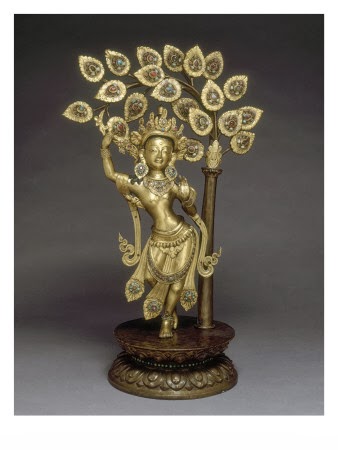
Maya - Mother of Buddha

Maya (mother of Buddha)

In the Buddhist Dharma Class I have been taking with Chris Chapple on Sunday mornings Chris started talking about Queen Maya.
 
Queen Māyā of Sakya (Māyādevī) was the birth mother of Siddhartha Gautama. She was queen at Kapilavastu married to King Sudhodhana. 

Māyā means "love" in Nepali. Māyā is also called Mahāmāyā ("Great Māyā") and Māyādevī ("Queen Māyā"). In Tibetan she is called Gyutrulma and in Japanese is known as Maya-fujin (摩耶夫人).
Maya and Sudhodhana did not have children for twenty years into their marriage. According to legend, one full moon night, sleeping in the palace during the monsoon season, the queen had a vivid dream. She felt herself being carried away by four devas (spirits) to Lake Anotatta in the Himalayas to the Tushita Heaven. After bathing her in the lake, the devas clothed her in heavenly cloths, anointed her with perfumes, and bedecked her with divine flowers. Soon after a white elephant, holding a white lotus flower in its trunk, appeared and went round her three times, entering her womb through her right side. Finally the elephant disappeared and the queen awoke, knowing she had been delivered an important message, as the elephant is a symbol of greatness in India.

The Brahmins interpreting the dream that Queen Maya was pregnant but Sudhodhana was not the father. Maya did infact become pregnant after the dream.

 According to Indian female tradition, Maya was on the way back to her parents house to give birth when she went into labor in the middle of the road in Lumbini. Maya is usually shown giving birth standing under a tree and reaching overhead to hold onto a branch for support. Her depiction resembles the tree spirits known as yaksini. She can also be seen as a surrogate for Durga.  Maya lifted up her leg to give birth and a perfectly formed child emerged.  She stayed in the spot the Buddha was born but couldn't stop bleeding. She was dead after 21 days.


Emotions

First assignment for new Graphic novel class with Andy Fish was emotions.  I did this assignment last year also.

angry

annoyed

enraged
angry

annoyed

enraged

Sunday, February 2, 2014

Sketching with Linda

I've been sketching a bit with Linda
Viva Cantina


Smokehouse

Hollywood and Highland

Hollywood and Highland

Hollywood Park


Hollywood Park

Hollywood Park

Smokehouse


Smokehouse

Smokehouse

Viva Cantina

Viva Cantina